When claims leaders talk about leakage, the conversation tends to drift to fraud. Fraud is real, but it is not where most money leaves a claims operation. Most of it leaves through ordinary, honest gaps: a notice that arrived late, a reserve nobody set properly, a payment nobody checked, a recovery nobody chased.
Leakage is the difference between what a claim cost and what it should have cost if it had been handled well. It is invisible on a single file and material across a book. This post lists the places it hides and how each one can be seen.
Eight places to look
| Indicator | Why it leaks | How to see it |
|---|---|---|
| Late notice | Evidence degrades, damage grows, mitigation is missed | Days from loss to report, by line and channel |
| Stair-stepped reserves | The claim was never evaluated; costs drift | Three or more increases inside 180 days |
| Held or duplicate payments | Money paid twice, or to the wrong party | Payment holds by code; duplicates caught |
| Expense ahead of indemnity | Defense and vendor spend outrun the claim's value | Expense against the line's usual ratio |
| Paid well past the first reserve | The first evaluation was wrong and nobody revisited it | Paid against the opening reserve |
| Open past a year | Old claims cost more and close worse | Age of open inventory |
| Reopens | Something was missed at close | Reopen rate by line and owner |
| Recovery not pursued | Subrogation, salvage and deductibles left on the table | Recovery potential with no opportunity opened |
These are the indicators InsightCW's claims analytics reports, from its own ledger, for the caller's book. Every figure on that page states its basis, and the measures are registered on the platform's metrics layer so the definitions read the same on the portfolio.
late notice"] L --> B["During:
stair-stepping, expense drift,
paid past first reserve"] L --> C["At payment:
duplicates, wrong payee"] L --> D["After:
recoveries not pursued,
reopens, old inventory"] style C fill:#fdecec,stroke:#e57373 style D fill:#fff4e2,stroke:#f4a03a
Seeing it is half of fixing it
Each indicator points at a control, and InsightCW has one for each:
- Late notice — the late-notice coverage referral and the late-report fraud indicator make it visible on the file the day it arrives.
- Stair-stepping — the worksheet rule and the reserving agent's basis.
- Duplicates and wrong payees — payment controls that hold rather than fail.
- Expense drift — legal bill review and vendor fee schedules, line by line.
- Recoveries — recovery rules and the subrogation agent, with limitation-date diaries.
- Reopens and old inventory — the closure checklist and the reserve-review item on Up next.
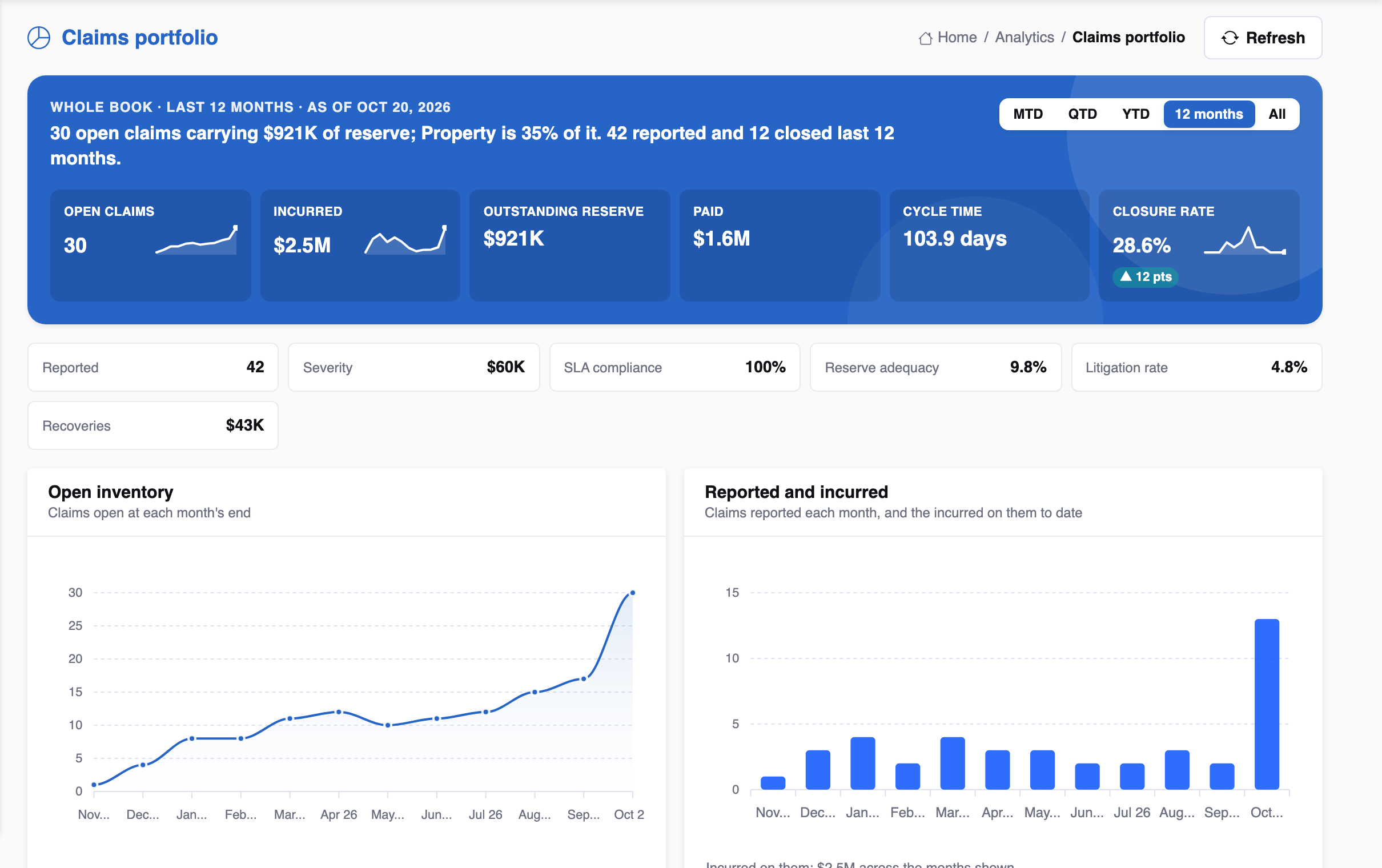
A note on numbers
We have deliberately put no industry percentage on this page. Leakage estimates vary widely and most are not comparable. The useful number is your own, measured the same way every month from your own ledger. Measuring it describes how.