Every claim runs on clocks, and some of them are the law. Unfair claims settlement practice rules, which most states adopt in some form, set deadlines for acknowledging a claim, deciding coverage, paying after agreement and keeping the claimant informed. The clocks start whether or not anyone is looking.
This post describes the clocks, how they are usually missed, and what tracking them properly takes. Nothing here is legal advice: the deadlines vary by state and line, and the defaults below are a starting point to replace with your compliance team's table.
The clocks InsightCW ships with
| Clock | Target | Statutory | Note |
|---|---|---|---|
| Acknowledge notice | 24 hours | Yes | Most states require prompt acknowledgement |
| First contact with the insured | 48 hours | No | Service standard |
| Coverage decision | 15 days | Yes | Within 15 days of completed proof of loss |
| Inspection scheduled | 72 hours | No | Service standard |
| Initial reserve set | 72 hours | No | Internal control |
| Payment after agreement | 5 days | Yes | Prompt payment after settlement |
| Status update to claimant | 30 days | Yes | Periodic status while open |
| Approval decided | 24 hours | No | A held reserve or payment waits a day at most |
Each clock is a definition with a warning point, a line and a jurisdiction where it differs, and a flag for whether it is statutory. Clocks run on the desk's business calendar, with its holidays and business hours, so a Friday-evening notice is not two days late on Monday morning.
How clocks are missed
silently"] --> B["Nobody owns it"] B --> C["Tracked in a
spreadsheet"] C --> D["Missed during
a busy week"] D --> E["Found in a market
conduct exam"] style E fill:#fdecec,stroke:#e57373
Clocks are missed because they are invisible until they are breached. A clock that is tracked in a separate spreadsheet is a clock that somebody has to remember to look at.
How InsightCW keeps them
- Clocks start by rule.
slarules in the Studio start the right clocks when a claim opens — the coverage-decision and initial-reserve clocks on every new claim, for example. A rule can start a clock on any condition a claims manager can write. - Clocks are on the decision record. Every Analyze lists the running clocks, breached ones first.
- Clocks drive the work queue. Up next ranks past-due clocks first, and lists clocks inside their warning window.
- The correspondence agent drafts what the clock calls for — the acknowledgement, the status update — for the adjuster to send.
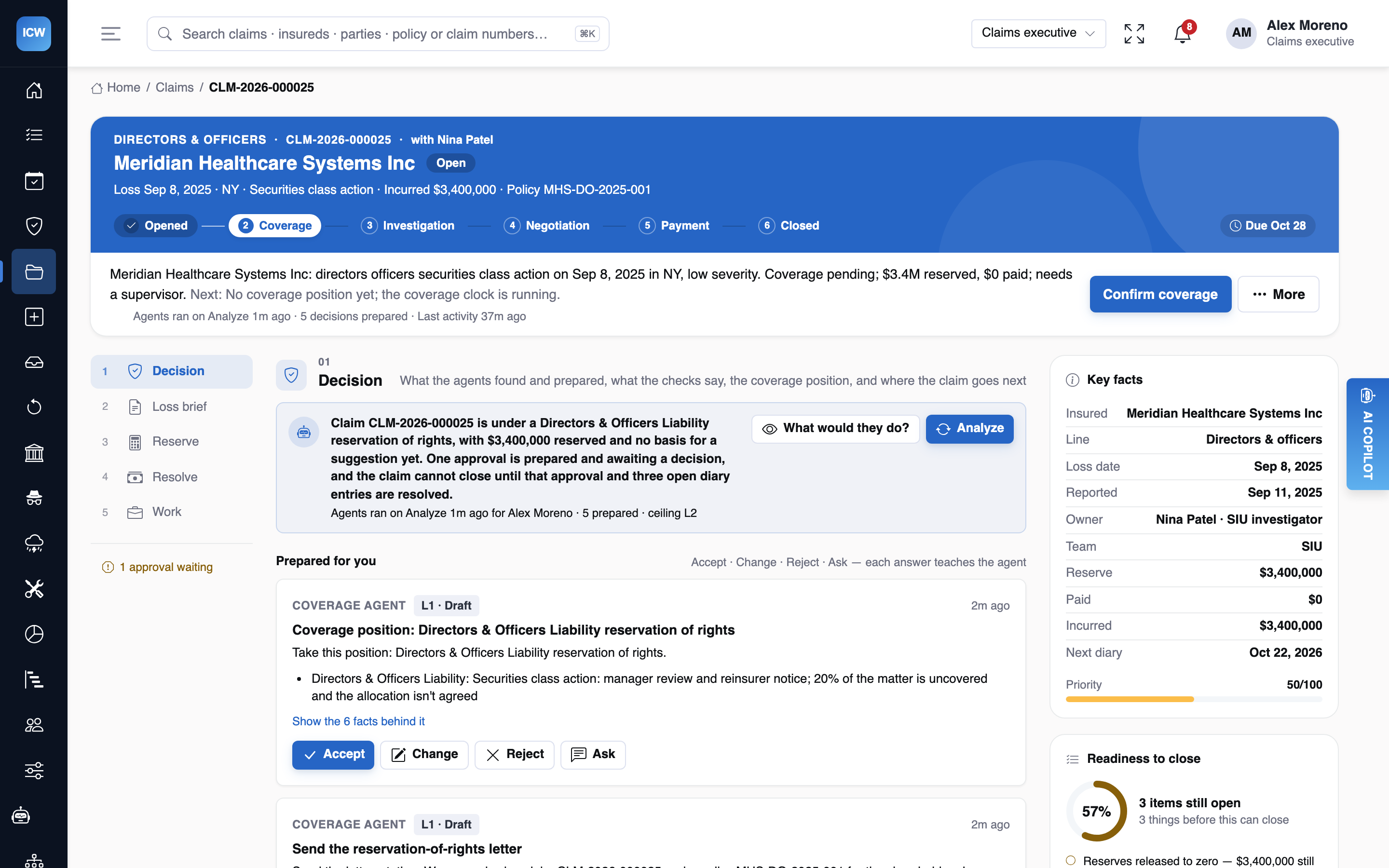
- Stage actions meet clocks. Confirming coverage meets the coverage clock; recording the reason on the history row keeps the evidence.
Replace the defaults
The seeded clocks are reasonable starting points, not a compliance programme. Load the deadlines for the states and lines you write, with their jurisdiction and line, in the Service levels admin page.