A small manufacturer reports water damage to its stockroom — seventy-four days after a pipe burst. In the meantime its policy has renewed with a higher deductible and a new water-damage endorsement. Which policy answers? The one in force today, which every screen in most claims systems shows, or the one in force on the day of the loss, which is the only one that matters?
Late notice is a coverage question, a prejudice question and sometimes a fraud question, and it is decided on the policy as it stood on the loss date. This post follows one late-reported claim through InsightCW: asking InsightUW for the policy at the loss date, the late-notice and fraud rules, the coverage agent's cautious position, and what the adjuster decides. The insured and amounts are illustrative.
| Actors | Property adjuster (owner), coverage counsel if needed, claims manager, the insured and broker |
|---|---|
| Trigger | A notice reported 74 days after the date of loss |
| Line | Commercial property (the rules apply to every line) |
| Agents involved | Intake, coverage, fraud, correspondence, supervisor |
| Decisions and authority | The coverage position on late notice (adjuster, with the manager on referral), whether the late report is a fraud indicator worth acting on |
| Systems touched | InsightUW (the policy at the loss date, not today's) |
| Outcome | The right policy, the right deductible and endorsements, a coverage position that names the late notice and what it does and does not prejudice |
| What is measured | Claims handled on the wrong policy term (should be zero), days to coverage position on late notices, late-notice referrals by outcome |
The wrong policy is the default
the current term"] B --> C["Today's deductible
and endorsements
applied"] C --> D["Coverage letter on
the wrong wording"] D --> E["Dispute; letter
withdrawn"] style C fill:#fdecec,stroke:#e57373 style E fill:#fff4e2,stroke:#f4a03a
Most claims systems copy a policy in at some point and show that copy. When a policy renews between the loss and the notice, the copy is the new term. Nobody chooses the wrong policy; the system chooses it for them.
as of the loss date"] B --> C["Dated cache:
as_of = loss date,
UW's answer verbatim"] C --> D["Rules: late notice
60+ days; late report
indicator 30+ days"] D --> E["Coverage agent:
cautious position,
cited to the prior term"] E --> F{"Adjuster decides;
manager on referral"} style B fill:#efeafe,stroke:#7c6cf0 style F fill:#e8f8f4,stroke:#22c1a4,stroke-width:2px
How InsightCW asks UW
InsightCW does not own policies. When a notice names a policy number, it asks InsightUW one
question: what did this policy say on this date? The call is service-to-service, read-only and
signed. UW answers with the term, limits and aggregate, deductible or retention, coverage lines,
the forms and endorsements on the quote schedule, and the trigger (occurrence, or claims-made
with a retro date). CW keeps the answer verbatim with the loss date as its as_of,
copies coverage onto the claim from it, and erodes the aggregate by what it has paid on the
policy's other claims.
Step by step
UW returns the prior term — the lower deductible and no water-damage endorsement. That is the policy the claim is handled on. If UW cannot be reached, CW uses whatever policy it already holds and says on the file that the answer did not come from UW.
Late notice of 60 days or more refers the coverage position. The policy-in-force rule (COV_NOT_IN_FORCE) stays quiet: the loss date is inside the prior term.
A notice 30 or more days after the loss raises a medium fraud indicator. It is an indicator, not an accusation; the score stays below the SIU threshold.
Water damage covered under the prior term's wording, with a reservation of rights on late notice and prejudice. It cites the prior term's forms, not the current ones. The position can only move towards caution, and a denial would need a form number on the policy at the loss date.
The late report's suspicious reading (the damage grew, or was not sudden) and its innocent one (the stockroom is rarely used; the owner was away). Recommendation: monitor, not refer.
Asks for when the leak was discovered, by whom, and photographs or invoices from the time — the facts that decide prejudice. Drafted from the template, held for the adjuster.
With the discovery date established, the manager agrees the reservation of rights. The coverage clock is met and the decision record keeps the position, the prior-term form it cited and the referral it answered.
What the screens show
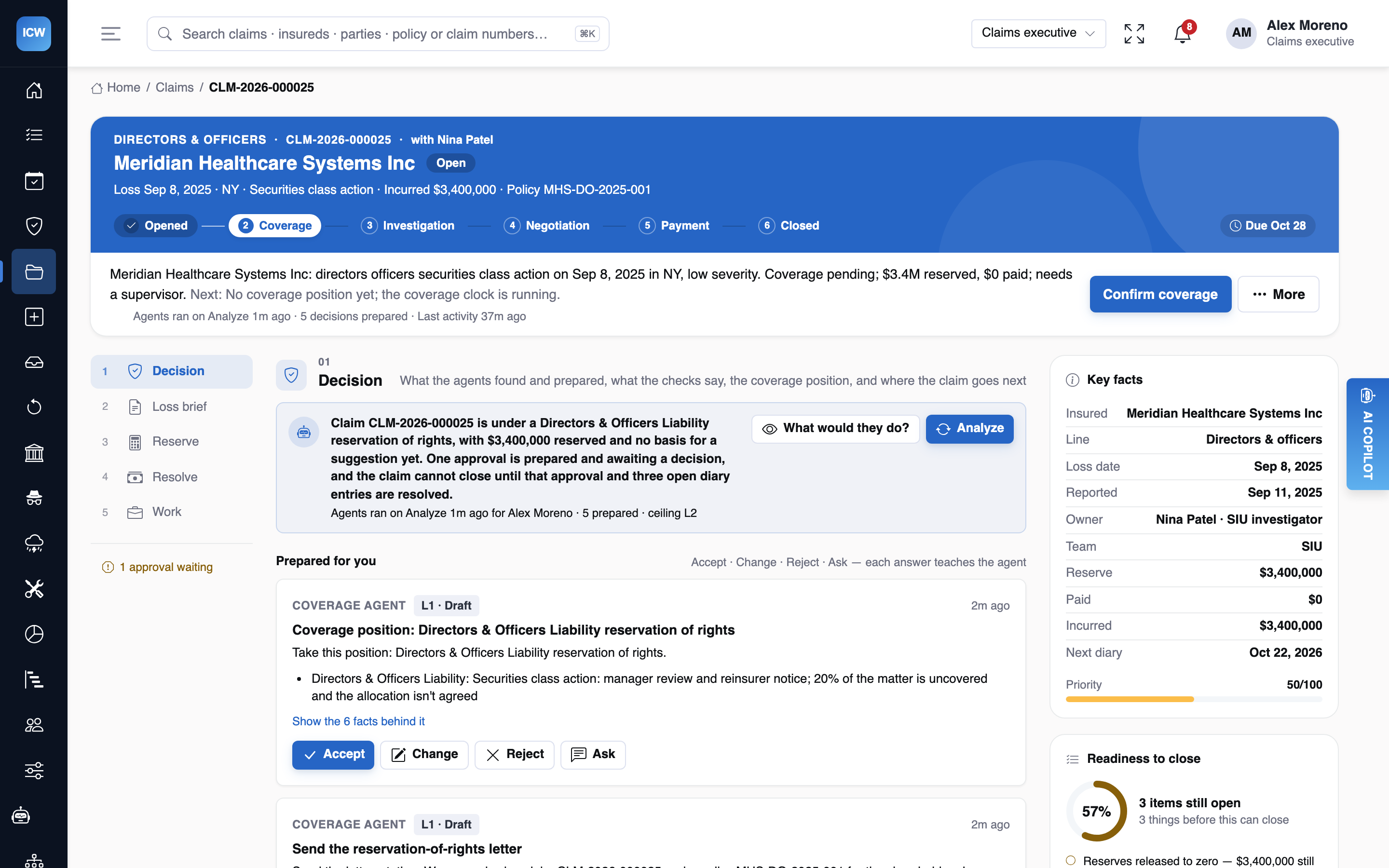
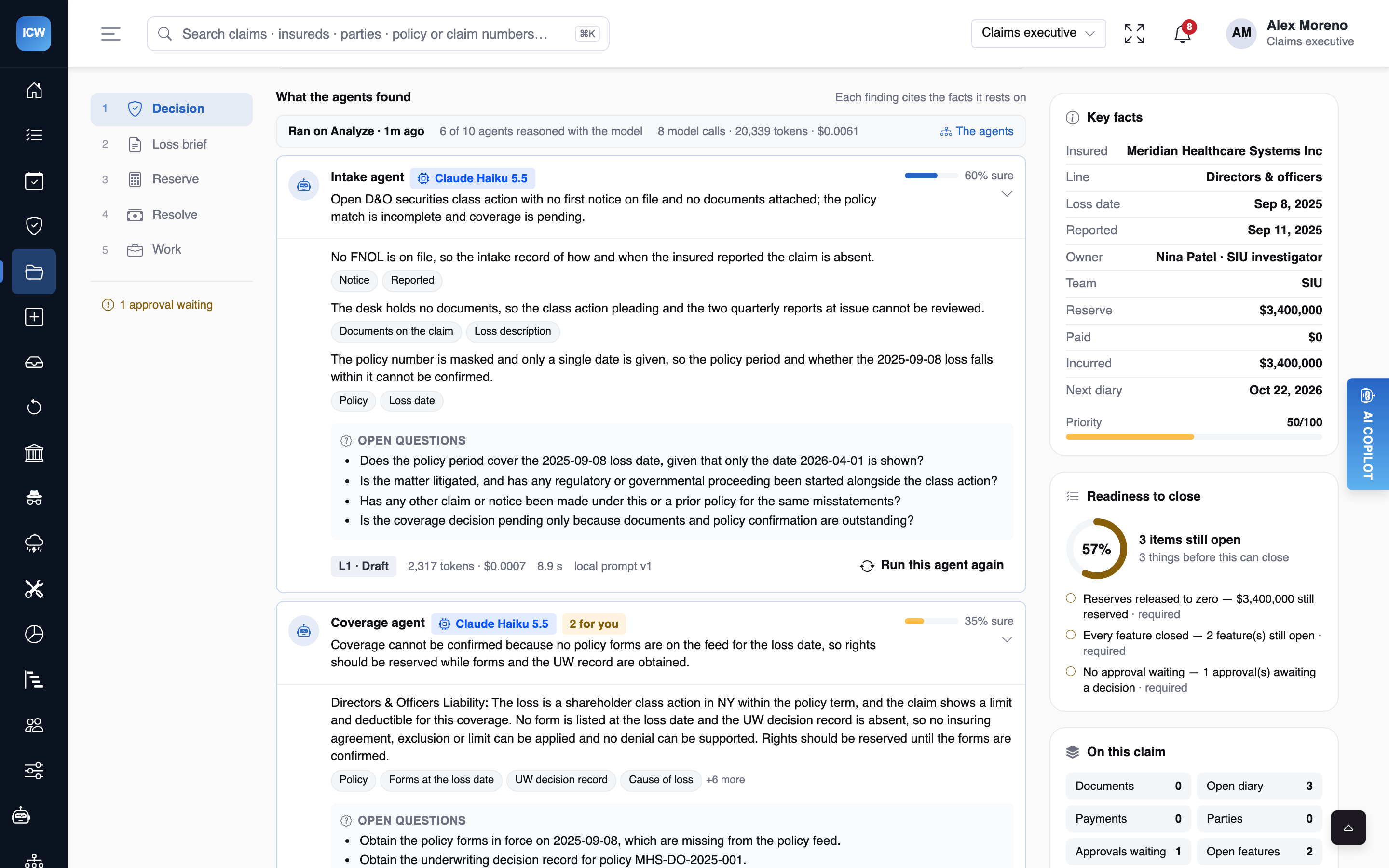
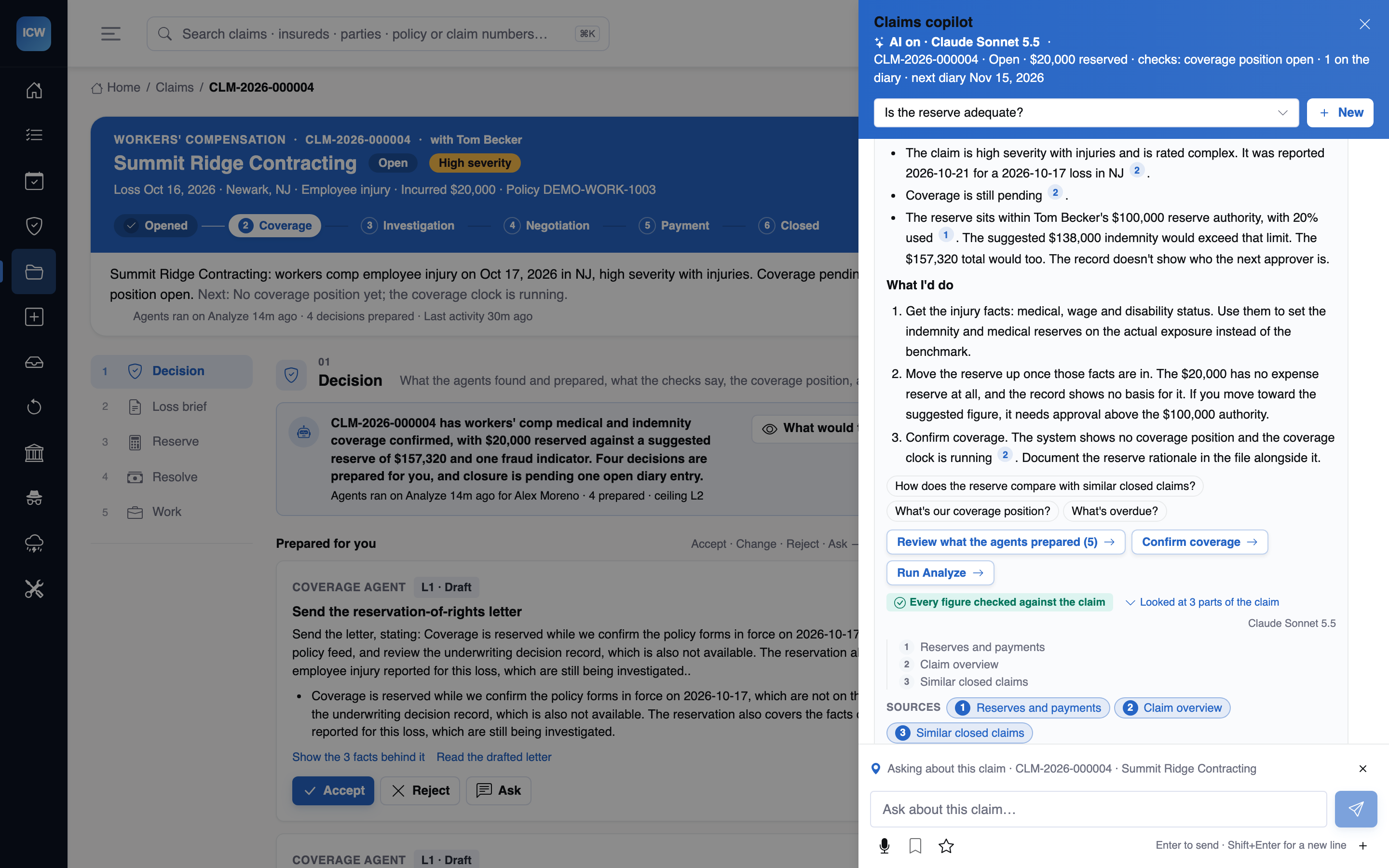
What the agents said, and what each answer rests on
| Agent | What it prepared | What it cites | Who decides |
|---|---|---|---|
| Intake | Ask for the discovery date and contemporaneous evidence | Notice date, loss date, documents on file | Adjuster sends |
| Coverage | Covered under the prior term; reservation of rights on late notice | UW's answer as of the loss date; COV_LATE_NOTICE | Adjuster; manager on referral |
| Fraud | Monitor, do not refer | FRD_LATE_REPORT, the score, the facts on file | Adjuster |
| Correspondence | Acknowledgement due on the 24-hour clock | The acknowledgement clock | Adjuster sends |
Edge cases
| What happens | What InsightCW does |
|---|---|
| The loss date is outside every term | COV_NOT_IN_FORCE refers; the coverage agent cannot call it covered. |
| The loss date changes after investigation | The policy is asked for again as of the new date; every cached answer carries the date it was asked for. |
| Loss within 30 days of inception | COV_EARLY_LOSS refers, and the recent-policy fraud indicator rises. |
| A claims-made policy | The question becomes when the claim was first made and the retro date, as in the D&O post. |
The decision record for this claim
| Section | Hit | Outcome |
|---|---|---|
| Coverage | Water damage covered under the prior term (policy at the loss date from UW) | warn |
| Coverage | COV_LATE_NOTICE: late notice of 60 days or more | refer |
| Fraud | Score 15: FRD_LATE_REPORT (30 days or more after the loss) | warn |
| Clocks | Acknowledgement met; coverage decision clock running | warn |
| Agent | Coverage: reservation of rights on late notice and prejudice (source: agent) | warn |
Verdict refer. The record names the policy term the claim was handled on, which is the first thing anyone will ask if the position is disputed.
Ask the copilot
| Ask the copilot | Lookups it calls | What the answer covers |
|---|---|---|
| “Which policy term applies?” | policy_and_coverage | The term in force on the loss date, its deductible and forms, and that the answer came from UW. |
| “How late was this reported?” | claim_overview, decision_record | Loss and report dates, the days between, and the rules that fired. |
| “What do we still need to decide prejudice?” | notes, documents, diary_and_clocks | What is on file and what the information request asked for. |
Tuning it for your book
- The late-notice threshold. 60 days is the default for the coverage referral and 30 days for the fraud indicator. Some lines and states need different numbers.
- The UW connection. Configure the signed lookup so CW always asks UW. A fallback policy is labelled as such; aim never to need it.
On the desk
You handle the claim on the policy that was in force, without looking for it. The late notice is a referral with the facts, not a surprise.
For claims IT
GET /uw_service/policies/{number}?as_of=YYYY-MM-DD, signed; the answer is cached verbatim in cw_policy with source_system and as_of.
For claims leadership
Claims handled on the wrong policy term should be zero. It is a measurable, auditable number.
Variations
A late notice on a claims-made policy
On claims-made wording, late notice is usually a reporting-provision question: was the claim reported within the policy period or the extended reporting period? The management-liability line facts and checks carry it, as in the D&O post.
A loss just after inception
COV_EARLY_LOSS refers a loss within 30 days of inception, and the recent-policy fraud
indicator rises. Most such losses are honest; the referral exists so the inception date is checked
against the loss date by a person.
No policy number on the notice
Intake cannot ask UW for a policy it cannot identify. The intake agent prepares an information request; the coverage agent says it has no policy to cite and prepares nothing.
Rolling it out
- Configure the UW lookup with its signed secret, and confirm it answers for a sample of policies that have renewed.
- Agree the thresholds for late notice (60 days) and the late-report indicator (30 days) with coverage counsel and SIU.
- Measure claims handled on the wrong term (zero) and days to coverage position on late notices.
Questions we get asked
What if UW is down when the notice arrives?
CW uses the policy it already holds — a seeded or manual policy — and says on the file that the answer did not come from UW. It asks again when it can.
Is a late report treated as fraud?
It raises a medium indicator, which on its own stays below the SIU threshold. The fraud agent weighs it and usually recommends monitoring.
Can an auditor replay what happened?
Yes. Every Analyze, stage action and payment hold writes a run to the decision record, with the hits in order, the rule and facts behind each, and the verdict. Every agent step records its model, tokens, cost and confidence, and a Lense trace when tracing is configured.
Which model do the agents use, and what if it is unavailable?
By default the agent steps use Claude Haiku 5.5 through the platform's model client (on Bedrock where a region is configured), with a daily budget per agent; over budget, the fast model answers. If no model is configured, or a call fails, or the answer does not parse, the agents' rule-based findings stand and the step says the model did not run. Nothing in the claim waits on a model.
What the person still decides
- Whether the late notice prejudiced the carrier. A legal and factual judgement.
- The coverage position and the letter.
- Whether the late report means anything beyond lateness.