A public company's general counsel forwards a securities class action complaint filed against the company and three of its officers. In management liability, the first decision is not about money. It is about coverage: was the claim first made inside the policy period, did the wrongful act happen after the retro date, which insuring agreements respond, and what does the carrier reserve its rights on before anything else is said.
Get the coverage letter wrong and everything that follows is argued on the wrong footing. This post follows one D&O notice through InsightCW: the policy at the loss date from InsightUW, the claims-made checks, the coverage agent's cited position, the reservation-of-rights letter, and the tower. The company, the case and the amounts are illustrative. Nothing here is legal advice, and InsightCW does not offer any: it prepares the position and the letter for a person who owns them.
| Actors | Management liability claims professional (owner), coverage counsel, claims manager, the insured's general counsel and broker |
|---|---|
| Trigger | A notice of claim with a securities class action complaint attached |
| Line | Directors and officers (management liability family: D&O, E&O, employment practices, fiduciary) |
| Agents involved | Intake, coverage, reserving, litigation, correspondence, supervisor |
| Decisions and authority | The coverage position and the coverage letter (a person; the letter is held for pull-back if an agent ever sends it at L3), panel counsel, consent to settle, defense reserves inside authority |
| Systems touched | InsightUW (the policy as written: claims-made trigger, retro date, forms and endorsements, the tower), InsightCede (reserve movements, large-loss notice) |
| Outcome | A coverage position per insuring agreement, each one citing the form it rests on, and a reservation-of-rights letter the coverage professional signs off |
| What is measured | Days to coverage position (against the 15-day coverage clock), positions later reversed, defense spend against budget, tower erosion |
Why the first letter matters so much
A D&O policy is claims-made: it responds to claims first made during the policy period, usually for wrongful acts after a retroactive date. A securities class action typically names the company (entity coverage, often Side C) and individuals (Side A and Side B). Each insuring agreement has its own conditions, the retention applies to some and not others, and the tower of primary and excess policies erodes from the bottom.
by email"] --> B["Find the policy
PDF and endorsements"] B --> C["Read trigger, retro,
exclusions by hand"] C --> D["Draft ROR from
last year's letter"] D --> E["Coverage counsel
rewrites it"] E --> F["Letter goes out
day 25"] style F fill:#fdecec,stroke:#e57373 style C fill:#fff4e2,stroke:#f4a03a
The slow part is not judgement. It is assembling the policy as it stood on the right date — the forms, the endorsements, the retro date — and then turning a position into a letter that reserves exactly the right rights. InsightCW does the assembly and drafts the letter so the coverage professional spends their time on the judgement.
of the loss date"] B --> C["Line checks:
claim first made,
retro date, SCA,
tower erosion"] C --> D["Coverage agent:
position per insuring
agreement, cited"] D --> E["ROR drafted from
the governed template"] E --> F{"Coverage professional
edits and signs off"} F --> G["Letter sent;
decision record kept"] style D fill:#efeafe,stroke:#7c6cf0 style F fill:#e8f8f4,stroke:#22c1a4,stroke-width:2px
Who talks to whom
without one it becomes a reservation of rights Pro->>CW: Edit and send the ROR CW->>Mgr: ML_SCA referral: securities class action Mgr->>CW: Panel counsel, defense budget
Step by step
InsightCW does not own policies. It asks InsightUW what the policy said on the relevant date: the claims-made trigger and retro date, the limits and retention, the coverage lines, and the forms and endorsements on the quote schedule. UW's answer is kept verbatim and dated. If UW cannot be reached, CW falls back to the policy it already holds and says so on the file.
The management-liability panel asks for its own facts: the date the claim was first made, the case caption, court, class period and stage, panel counsel, and the tower — Side A, B and C limits and what each has eroded, the retention and how much is satisfied.
The management-liability rules read those facts: claim first made outside the policy period (ML_OUTSIDE_PERIOD), wrongful act before the retro date (ML_BEFORE_RETRO), securities class action (ML_SCA), covered and uncovered allocation not agreed (ML_ALLOCATION), and the tower with less than a quarter left (ML_EROSION). Here only the securities class action rule fires: a referral to the manager.
A position per coverage on the claim — on this policy, one per insuring agreement — each with its confidence and open questions, and each citing the form it rests on from UW's answer. The merge rules are strict: a position may only move towards caution (covered, then reservation of rights, then denied), and a denial needs a form number that is on the policy at the loss date — without one it becomes a reservation of rights.
The letter keeps its governed template. The model writes the variable text the template carries: the reasons each right is reserved, in the professional's register. It is prepared for a person, not sent.
The professional edits the reasons, takes the position with the Reserve rights action and sends the letter. The coverage clock is met. The decision record holds the position, the form it cited and who took it.
On the securities class action referral, the manager assigns panel counsel and approves the defense budget. The litigation agent now watches the suit (see the litigated claim post).
As defense costs are paid, the eroded amounts move. When less than a quarter of the tower is left, ML_EROSION refers the file again — before the excess carriers need to hear it from someone else.
What the coverage agent may and may not do
| The model may | The model may not |
|---|---|
| Explain why a position is what it is, citing the form and the fact | Move a position towards coverage that the rules made cautious |
| Move a position towards caution: covered to reservation of rights | Deny without a form number that is on the policy at the loss date |
| Write the reasons a reservation of rights states | Change the governed letter template around those reasons |
| List open questions for the professional | State a limit, retention or erosion figure that is not in UW's answer or the file |
What the screens show
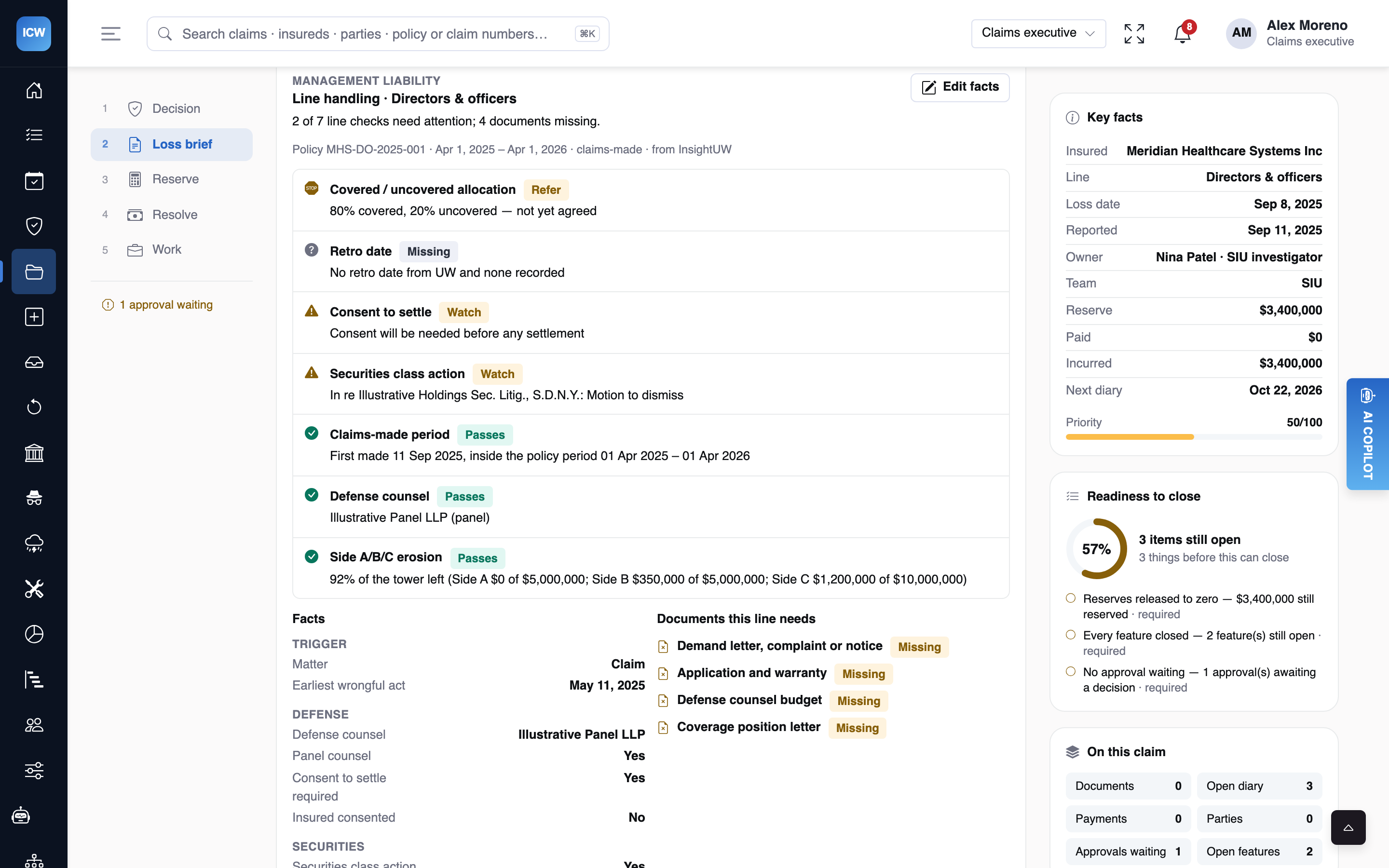
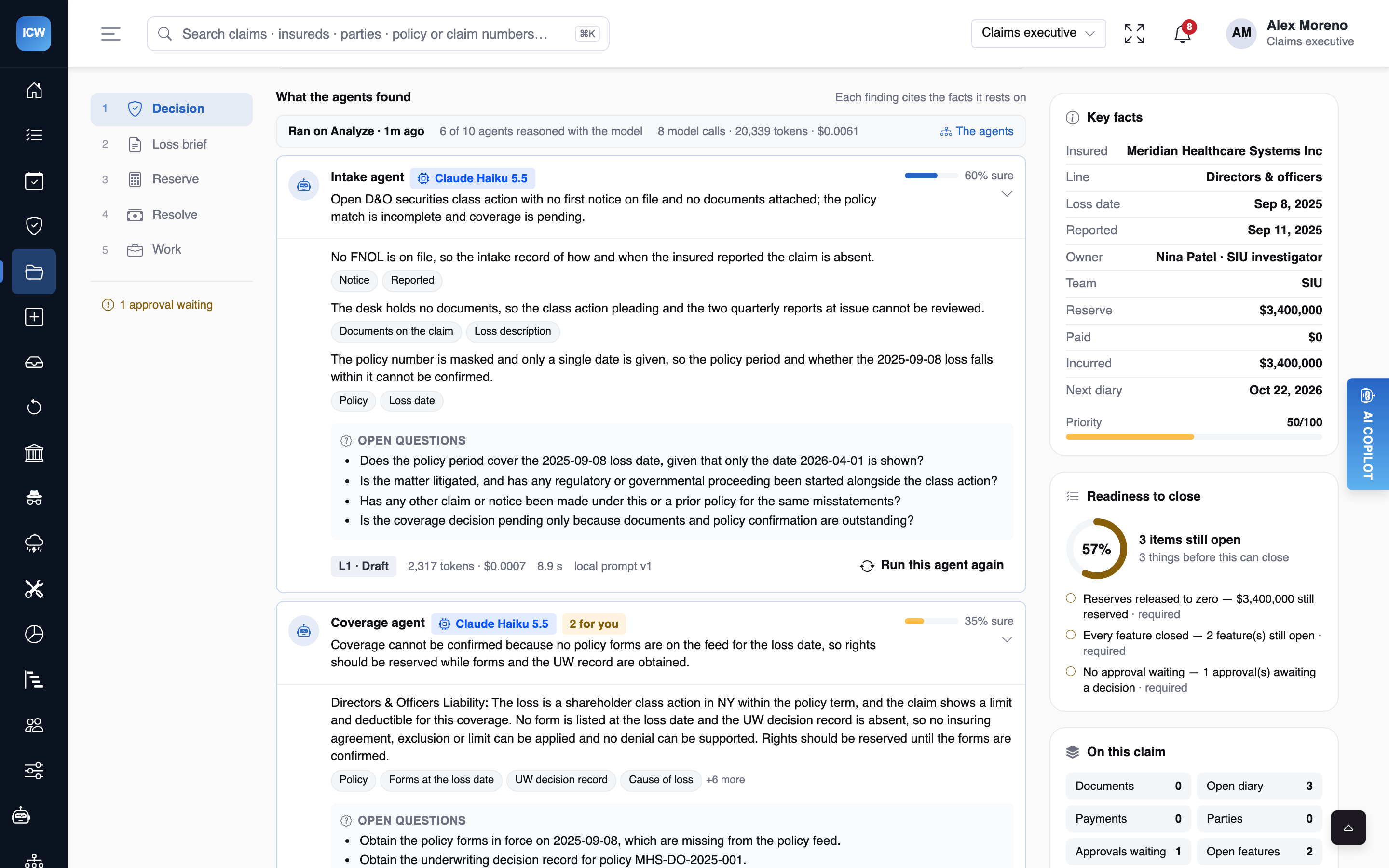
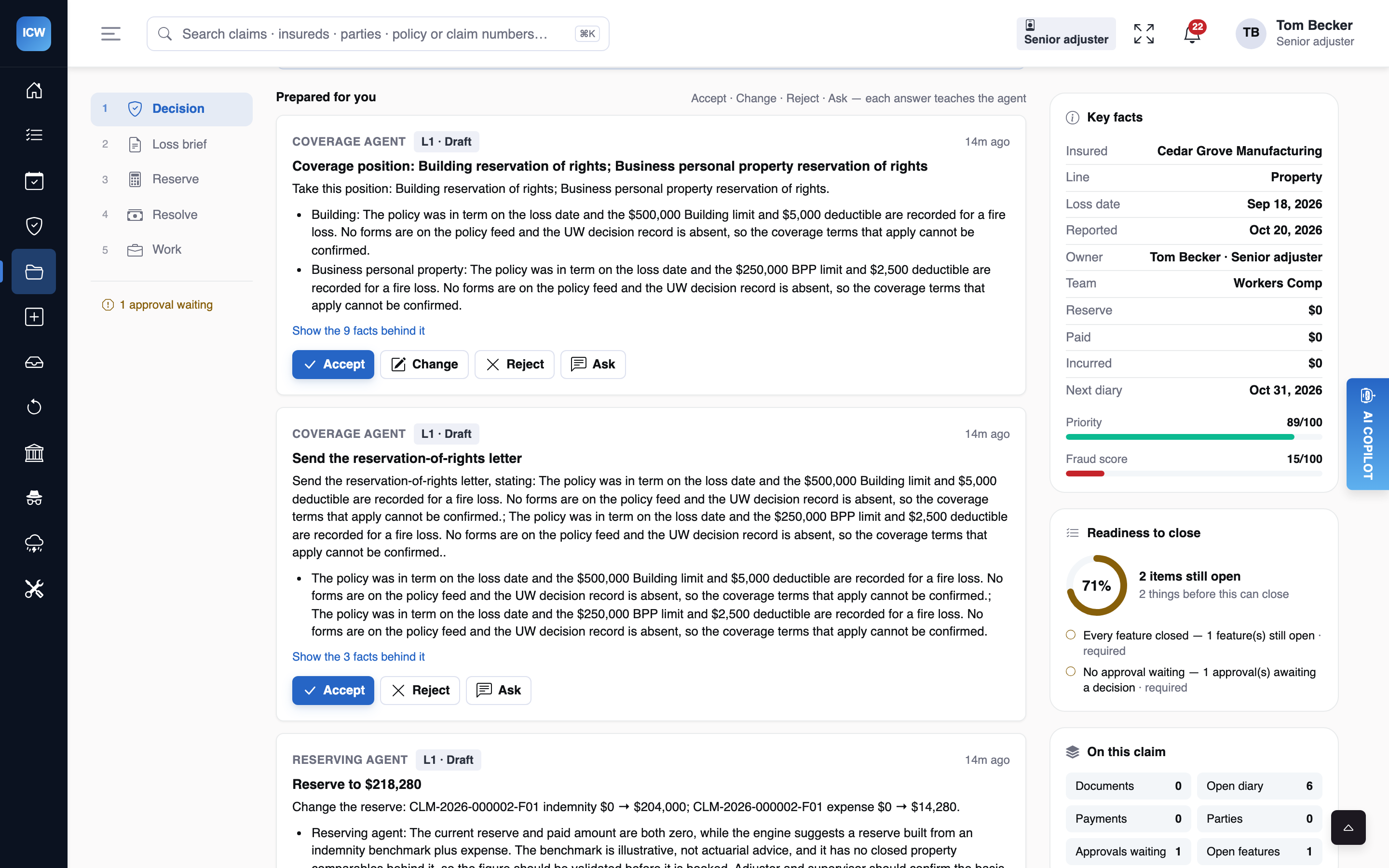
What the agents said, and what each answer rests on
| Agent | What it prepared | What it cites | Who decides |
|---|---|---|---|
| Intake | Notice complete; complaint attached; no earlier notice on the policy | Notice, documents, duplicate search | Professional |
| Coverage | Side A and B: reservation of rights; Side C: reservation of rights pending allocation | Insuring agreements, forms and endorsements on UW's answer, the claims-made dates, the retro date | Professional |
| Reserving | Defense reserve; indemnity left open with “no basis” until a settlement evaluation exists | Retention, defense budget, closed comparables (too few for indemnity) | Within authority |
| Litigation | Deadlines and a defense plan once the suit is recorded | The suit, the budget, the billing guideline | Claims manager |
| Supervisor | Brief for the securities class action referral | ML_SCA, the tower, the reserve history | Claims manager |
Edge cases, and how authority stops them
| What happens | What InsightCW does |
|---|---|
| The claim was first made last policy year | ML_OUTSIDE_PERIOD refers it; the coverage agent cannot call it covered, and the professional decides whether the earlier policy responds. |
| The wrongful act predates the retro date | ML_BEFORE_RETRO refers it. The retro date comes from UW unless the professional overrides it on the line panel, and the override is recorded. |
| The insured wants to settle without consent | ML_NO_CONSENT refers it before any settlement offer, and authority applies to the offer itself, not just the payment. |
| The model proposes “denied” without a form | It becomes a reservation of rights automatically. |
| UW is unreachable | CW uses the policy it already holds and says on the file that the answer did not come from UW today. |
The decision record for this claim
On day 3, when the reservation of rights was sent, the record held the coverage position itself as an event — who took it, what it cited and why — alongside the hits that led to it:
| Section | Hit | Outcome |
|---|---|---|
| Coverage | Each coverage under reservation of rights; form cited for each (policy at the loss date from UW) | warn |
| Line | Claims-made: claim first made inside the policy period | pass |
| Line | Wrongful act after the retro date | pass |
| Line | ML_SCA: securities class action | refer |
| Line | Tower: more than a quarter left (ML_EROSION quiet) | pass |
| Authority | Defense reserve inside the professional's authority | pass |
| Clocks | Coverage decision clock met on day 3 | pass |
| Event | Reservation of rights taken by the coverage professional, with the reason | warn |
Months later, when allocation is argued, the file shows the position as of day 3, the form it rested on, and that it came from UW's answer for the loss date — not from a PDF someone found in a shared drive.
Ask the copilot
| Ask the copilot | Lookups it calls | What the answer covers |
|---|---|---|
| “What's our coverage position?” | policy_and_coverage, decision_record | Each coverage's position with its form, limit, remaining limit and the reason, numbered to its sources. |
| “How much of the tower is left?” | policy_and_coverage, reserves_and_payments | Side A, B and C limits and erosion, the retention and how much is satisfied, from the line facts and the ledger. |
| “Draft a status update to the insured” | claim_overview, diary_and_clocks, notes | A draft the professional edits; the copilot suggests the letter action as a link and sends nothing. |
| “What did we tell the insured and when?” | notes, documents, decision_record | The reservation of rights and later letters, with dates; privileged notes are never returned. |
Tuning it for your book
- The coverage letter templates. The reservation-of-rights and denial letters are governed templates: the model writes only the variable reasons. Have coverage counsel own the templates.
- The erosion threshold.
ML_EROSIONrefers when less than a quarter of the tower is left. Excess carriers may want notice earlier; change the rule. - The UW connection. The policy at the loss date is only as good as what UW holds. Where policies were written before UW, load them so the lookup has an answer.
On the desk
The policy as it stood, the line facts, a cited position per coverage and a draft letter are on the page on day one. Your time goes on judgement and wording.
For claims IT
The policy comes from UW's signed, read-only lookup and is cached verbatim with its as_of; line rules read the management-liability facts; the coverage merge rules only move towards caution.
For claims leadership
Coverage letters are where disputes start. Measure days to position against the 15-day clock and positions later reversed.
Variations on this claim
An employment practices claim
The management-liability family covers employment practices and fiduciary as well as D&O and
E&O, so the same trigger checks apply. The coverage agent's position cites the EPL form;
allocation between covered and uncovered loss (ML_ALLOCATION) is often the live
question, and it is referred until it is agreed.
A regulatory investigation, not a suit
Whether an investigation is a “claim” is a wording question. The coverage agent can cite the definition from UW's forms and list it as an open question; it cannot settle it, and its position cannot move towards coverage on its own. The professional decides.
Settlement without consent
If the insured wants to settle without the carrier's consent, ML_NO_CONSENT refers it
before an offer is made. Authority applies to the offer, not just the payment, because an offer is
what binds the carrier.
Excess layers in play
As defense and indemnity erode the primary, the tower facts on the line panel move with the ledger. When less than a quarter is left, the erosion rule refers the file, which is the moment to put the excess carriers on notice.
Rolling it out on your desk
- Templates first: coverage counsel reviews the reservation-of-rights and denial templates. The model only fills the reasons; the template is the governance.
- UW coverage: confirm the lookup returns forms, retro dates and the tower for your management-liability book. Where UW's data is thin, the coverage agent says so.
- Coverage agent at L1, then L2: read its cited positions against your professionals' for a month before they arrive as decisions. The letter action never acts alone below L3, and the ceiling ships at L2.
- Measure: days to coverage position against the 15-day clock, and positions later reversed.
Questions we get asked
Does the coverage agent give legal advice?
No. It prepares a position and a draft letter for a coverage professional, citing the forms UW returned for the loss date. The professional owns the position and the words.
What if UW does not have the forms?
The coverage agent cites what it has and lists what it lacks as an open question. It cannot deny without a form number on the policy at the loss date.
Can an auditor replay what happened?
Yes. Every Analyze, stage action and payment hold writes a run to the decision record, with the hits in order, the rule and facts behind each, and the verdict. Every agent step records its model, tokens, cost and confidence, and a Lense trace when tracing is configured.
Which model do the agents use, and what if it is unavailable?
By default the agent steps use Claude Haiku 5.5 through the platform's model client (on Bedrock where a region is configured), with a daily budget per agent; over budget, the fast model answers. If no model is configured, or a call fails, or the answer does not parse, the agents' rule-based findings stand and the step says the model did not run. Nothing in the claim waits on a model.
What the person still decides
- The coverage position. Always. The agent prepares, cites and drafts.
- The words of the letter. The model fills the reasons; the professional owns them.
- Counsel, allocation and consent. Relationship and legal judgement, not rules.
For how the policy at the loss date matters even more on a late notice, see the late-reported claim.