Closing a claim sounds like the easy part. The settlement is agreed, the payment has gone out, the file is quiet. And yet closed claims are where some of the most expensive surprises live: a reserve left standing on a closed file, a payment issued before the release was signed, a recovery nobody concluded, a claim that reopens because the closing letter never went.
This post follows a general liability claim through its last week in InsightCW: the settlement controls, the closure agent's checklist, what blocks a close and why, releasing reserves through the ledger, the closing letter, and the events that tell InsightUW, InsightCede and InsightPulse. The claim and amounts are illustrative.
| Actors | Adjuster (owner), supervisor (settlement authority above the adjuster), the claimant's attorney |
|---|---|
| Trigger | A settlement agreed and paid on a bodily-injury feature |
| Line | Any; this example is general liability |
| Agents involved | Closure, correspondence, supervisor, reserving |
| Decisions and authority | The settlement offer (authority on the offer), the close (a person — capped at L2), any override of a blocker (with a reason) |
| Systems touched | InsightCede, InsightUW and InsightPulse (claim.closed, the reserve released) |
| Outcome | A claim that leaves the open book with no live money, a signed release on file and the closing letter sent |
| What is measured | Reopen rate, days from final payment to close, closed claims with reserve remaining (should be zero), settlements paid without a release (should be zero) |
Three controls that exist because their absence costs money
| Control | Why it is there |
|---|---|
| Authority on the offer, not the payment | An offer is what binds the carrier. Checking authority when the cheque is cut is too late: the number has already been said to the claimant's lawyer. |
| No payment before a signed release | Paying first and papering later is how a carrier pays twice for the same injury. |
| No closing over live money | Reserves released, payments issued, approvals decided — before a claim leaves the open book. |
to closed"] C --> D["Reserve left
standing"] C --> E["Release never
filed"] D --> F["Reopened; numbers
restated"] E --> F style F fill:#fdecec,stroke:#e57373
settlement authority"] --> B["Release signed
and recorded"] B --> C["Payment through
controls and authority"] C --> D["Closure agent:
the checklist"] D --> E{"Every item met?"} E -->|"no"| F["Blockers named;
close refused"] E -->|"yes"| G["Close prepared with
the closing letter"] G --> H{"Person closes"} H --> I["Reserves released through
the ledger; features closed;
claim.closed sent"] style D fill:#efeafe,stroke:#7c6cf0 style H fill:#e8f8f4,stroke:#22c1a4,stroke-width:2px
The closure checklist
The Claim Workspace shows the checklist on every open claim, not just at the end, so nobody discovers a blocker on the day they meant to close.
| Item | Kind |
|---|---|
| Reserves released to zero | Hard |
| Every feature closed | Hard |
| No payment waiting to be issued or released | Hard |
| No approval waiting | Hard |
| No negotiation open | Hard |
| Signed release on file for any settlement | Hard |
| Recoveries concluded | Soft — a claim can close over an open recovery |
Who talks to whom
Step by step
The offer is checked against settlement authority before it is made. Above the adjuster's limit it goes to the supervisor as an approval, prepared by the supervisor agent.
The signed release arrives as a document and is recorded on the settlement. Until it is, the payment of the settlement cannot be issued.
Payment controls and authority run. Requesting the payment re-runs the agents.
It works the checklist. The reserve is not yet zero and the expense feature is open, so it does not prepare a close; it lists exactly what remains.
Issued; claim.payment_issued to InsightCede and InsightUW.
Every hard item met. It prepares the close with the closing letter drafted from the template. It cannot close: closing a claim is capped at L2.
Close releases every remaining reserve through the ledger (each release is a cession movement), closes the features, and moves the claim to Closed through the one status owner, with the reason on the history row and the decision record. claim.closed goes to InsightCede, InsightUW and InsightPulse.
The closing letter is sent by the adjuster from the draft. In this build communications run as a dry run until a carrier connects its mail.
What the screens show
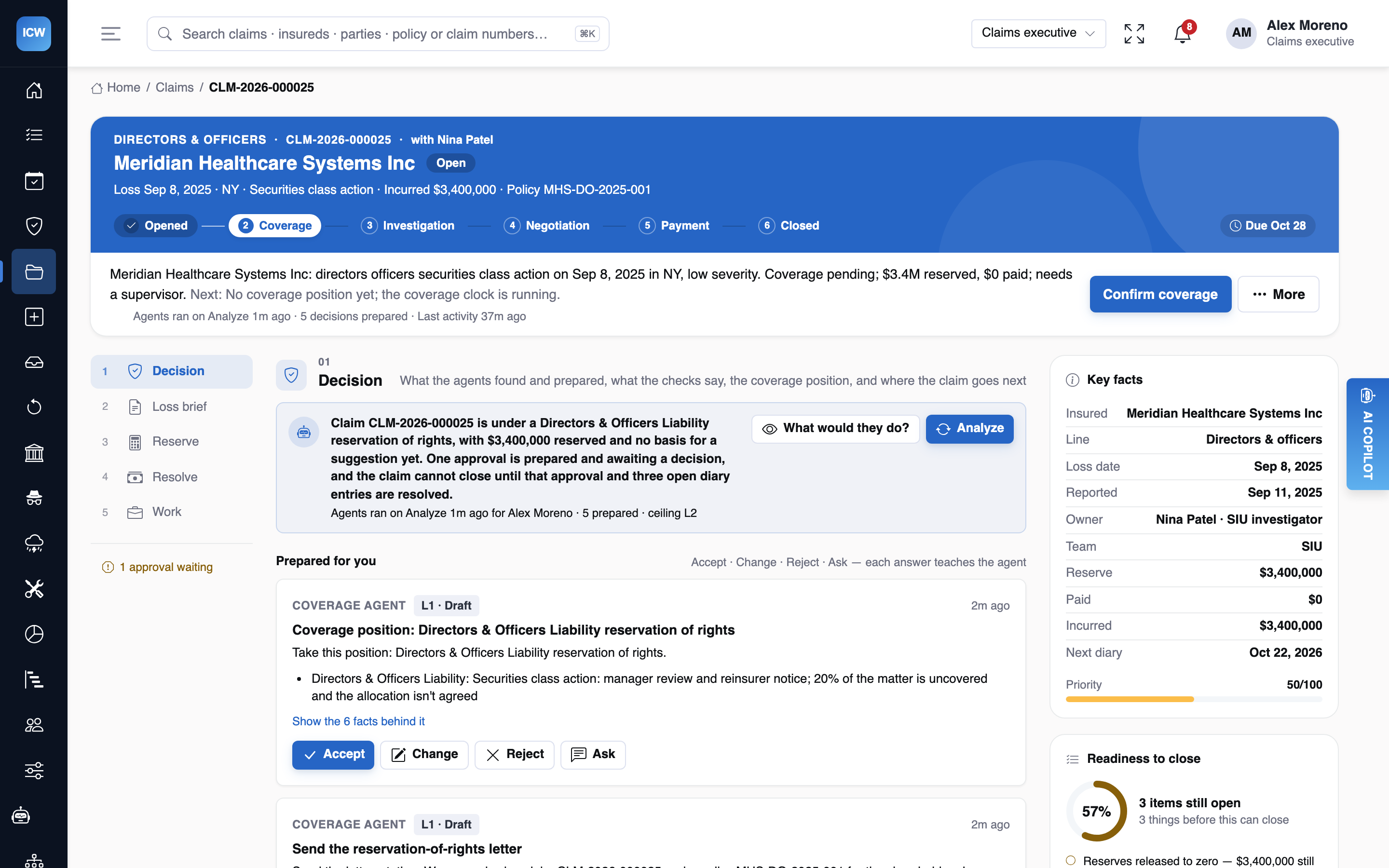
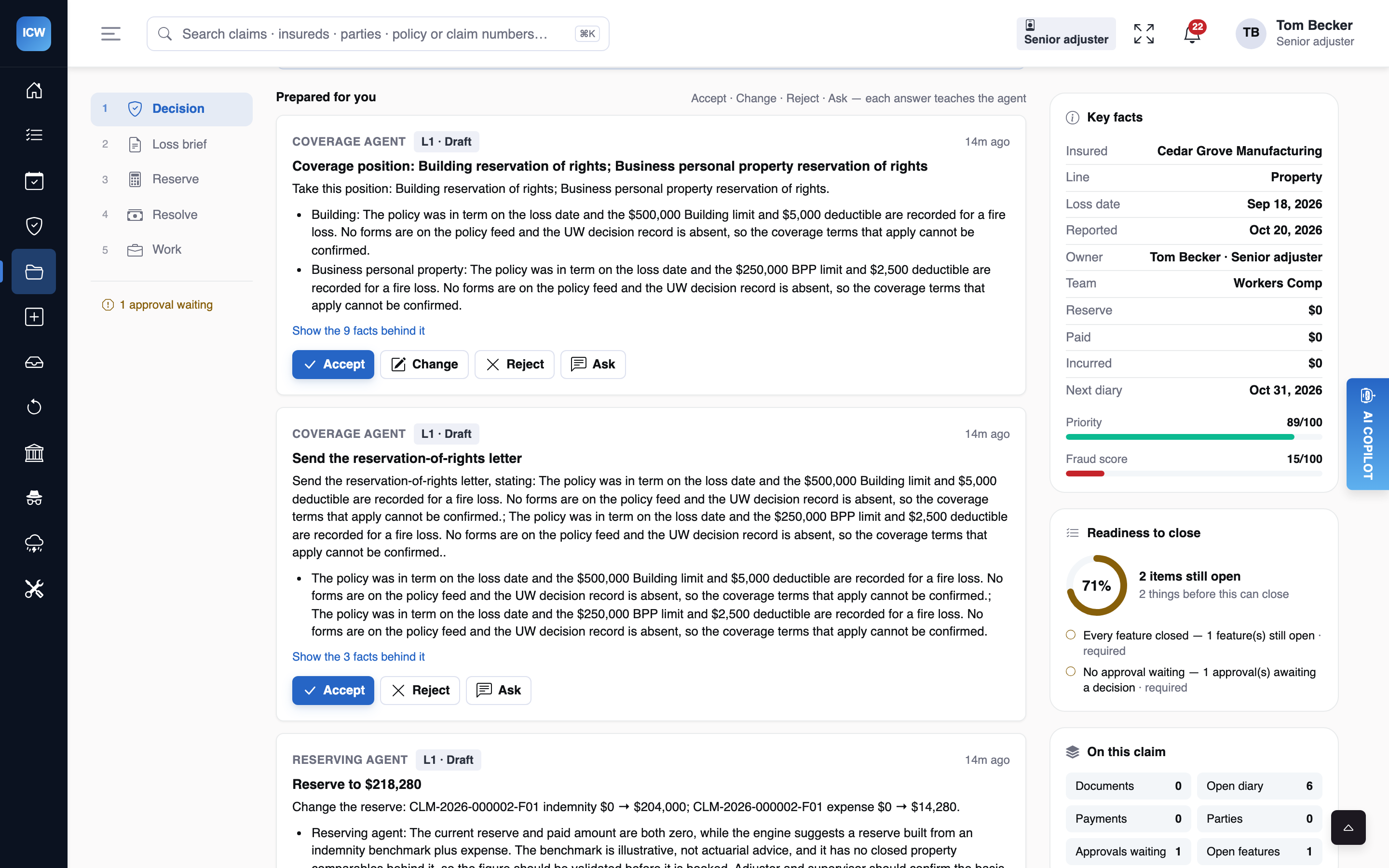
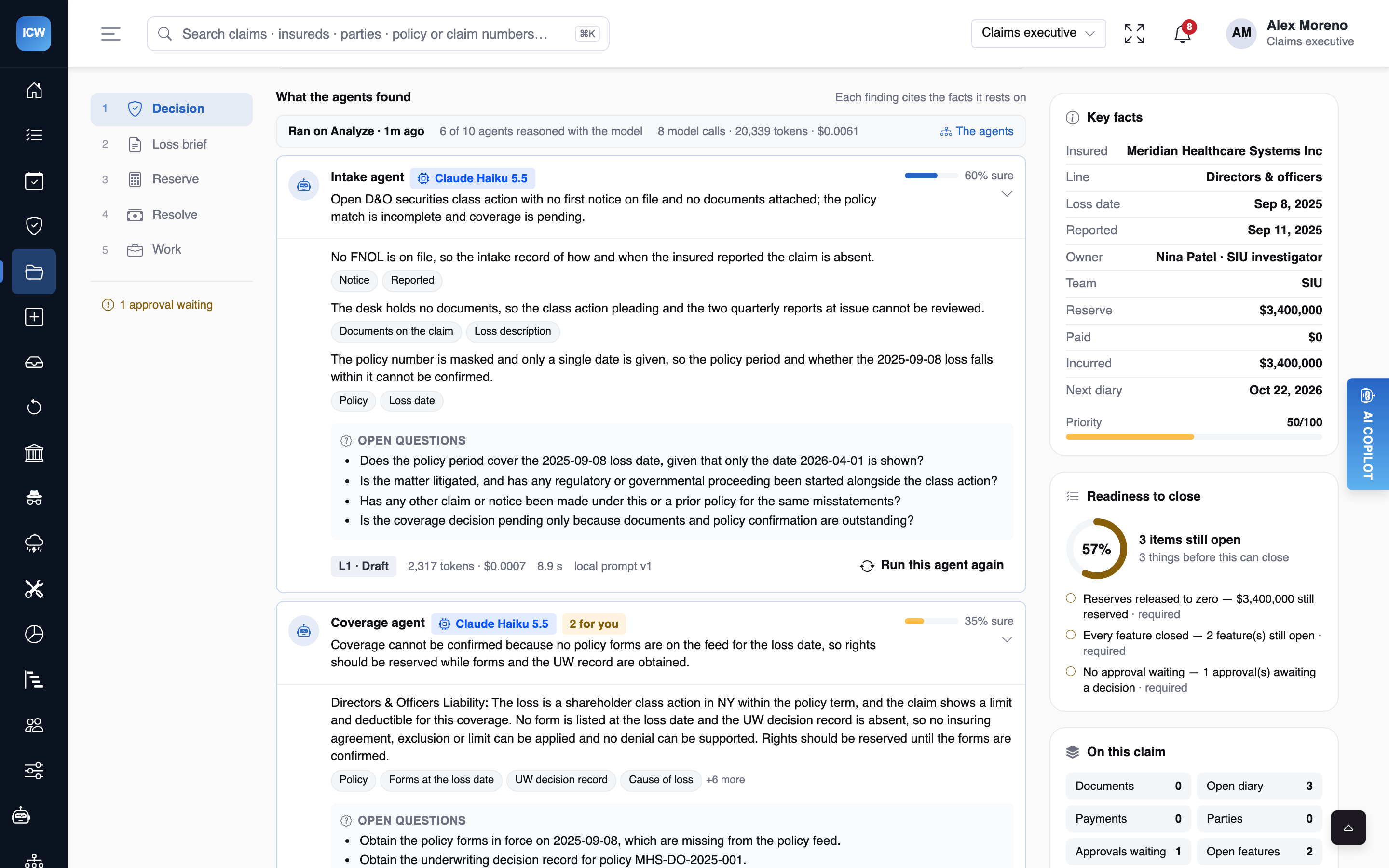
What the agents said, and what each answer rests on
| Agent | What it prepared | What it cites | Who decides |
|---|---|---|---|
| Closure | Day 3: not ready (reserve standing, expense feature open). Day 5: ready; close prepared | The checklist: ledger balances, features, payments, approvals, negotiation, release, recoveries | A person, always |
| Correspondence | Closing letter drafted | The template, the settlement, the parties | Adjuster sends |
| Supervisor | Settlement approval brief, if above authority | Authority gap, evaluation range, precedent | Supervisor |
Edge cases
| What happens | What InsightCW does |
|---|---|
| Someone tries to close with a reserve standing | The close is refused and says why; nothing changes. A blocker can be overridden only with a reason, which is recorded. |
| A subrogation recovery is still open | That item is soft: the claim can close over it, and the recovery continues. |
| New information after close | Reopen, with a reason; claim.reopened tells the other products, and reopen rate is a measured indicator. |
| An agent's level is raised to L4 | Closing stays capped at L2. |
The decision record at close
Closing is a stage action, and a stage action writes a decision-record run with its reason:
| Section | Hit | Outcome |
|---|---|---|
| Coverage | Bodily injury covered; settled | pass |
| Authority | Settlement inside authority on the offer; no approval waiting | pass |
| Readiness | Every hard checklist item met; no recovery open | pass |
| Event | Closed by the adjuster with the reason; reserves released through the ledger | pass |
What a refused close looks like
On day 3, before the payment was issued, the adjuster could have tried to close. The answer would have been a refusal listing exactly what blocks it — “$4,200 still reserved”, “expense feature open”, “payment waiting to be issued” — and nothing would have changed. A refusal is not an error; it is the checklist speaking. The amounts are illustrative.
Ask the copilot
| Ask the copilot | Lookups it calls | What the answer covers |
|---|---|---|
| “Is this claim ready to close?” | claim_overview, reserves_and_payments, diary_and_clocks | Each checklist item, met or not, with its source. |
| “Has the release been signed?” | documents, reserves_and_payments | The release document and the settlement it belongs to. |
| “Draft the closing letter” | claim_overview, parties_and_approvals | A draft to edit; the letter action as a link. |
Tuning it for your book
- Soft versus hard. Recoveries are soft by default so a claim can close over a long subrogation. If your accounting needs recoveries concluded first, say so.
- Overrides. Decide who may override a blocker and review overrides monthly; they are on the record with reasons.
- The closure agent. Capped at L2. Start it at L2 so ready claims arrive as a decision.
On the desk
The checklist is on every claim from day one; the close is prepared when it is ready; nothing lets you close over live money.
For claims IT
Status changes go through one owner with an allowed-moves map, a history row, an audit entry and the closure gate.
For claims leadership
Reopen rate and closed claims with reserve remaining are the honest measures of closing well.
Variations
Closing a claim with no payment
A claim that resolves without payment — withdrawn, or found not covered — still has a reserve to release and features to close. The checklist is the same; the close releases the reserve through the ledger, and that release reaches InsightCede as a movement like any other.
Closing over a long subrogation
The recovery item is soft, so a claim can close while the recovery continues. The recovery stays visible on the Recoveries page and its limitation diary stays live.
A reopened claim
Reopen needs a reason, moves the claim to reopened through the same status owner, and
sends claim.reopened. The agents run again on the next change; the closure agent will
prepare the next close when the checklist allows.
Rolling it out
- Clean the open book: run the checklist across open claims; claims that are effectively closed but carry a reserve are the first win.
- Closure agent at L2: ready claims arrive as decisions.
- Review overrides monthly.
- Measure: reopen rate, closed claims with reserve remaining, settlements paid without a release.
Questions we get asked
Can a claim be closed with a reserve standing?
Not without an override, and an override needs a reason that is recorded. The default is a refusal that names the blocker and changes nothing.
Who is told when a claim closes?
InsightCede, InsightUW and InsightPulse receive claim.closed, and every reserve released at close is a reserve movement Cede cedes.
Can the closure agent close a claim at L4?
No. Closing is capped at L2: the agent prepares the close and a person closes.
Which model do the agents use, and what if it is unavailable?
By default the agent steps use Claude Haiku 5.5 through the platform's model client (on Bedrock where a region is configured), with a daily budget per agent; over budget, the fast model answers. If no model is configured, or a call fails, or the answer does not parse, the agents' rule-based findings stand and the step says the model did not run. Nothing in the claim waits on a model.
What the person still decides
- The settlement, inside authority, before it is offered.
- The close, always.
- Any override of a blocker, with a reason the auditor will read.