A rear-end collision is the most ordinary claim an auto desk handles. The insured was stopped at a light, the other driver was not, and the police report says so. The physical damage gets paid inside a week. The money that should come back from the other driver's carrier often never does — not because anyone decided against it, but because nobody was holding the file when the moment came.
This post follows one such claim through InsightCW from the first notice to the recovery landing in the ledger, and shows where each agent helps, what it cites and where a person still decides. The claim, the people and the amounts are illustrative; the screens, the rules and the agents are the product as it ships.
| Actors | Auto adjuster (owner), senior adjuster (authority above the adjuster's limit), recovery specialist, the insured, the adverse driver and their carrier |
|---|---|
| Trigger | A first notice of loss for a two-vehicle collision, reported the day after the loss |
| Line | Personal or commercial auto, physical damage and property damage features |
| Agents involved | Intake, coverage, reserving, subrogation, correspondence, supervisor, closure |
| Decisions and authority | Coverage confirmation (adjuster), reserve and payment within the seeded authority matrix, opening the subrogation opportunity (a person, always — the action is capped at L2) |
| Systems touched | InsightUW (policy at the loss date), InsightCede (cession movements and the recovery as a contra cession), InsightPulse (portfolio events) |
| Outcome | The insured is paid net of deductible, the carrier recovers from the adverse carrier, the deductible goes back to the insured, the claim closes clean |
| What is measured | Days notice-to-payment, subrogation identified rate, recovery yield against paid, days to demand, limitation-date misses (should be zero) |
How this claim usually goes
Without a workbench, the claim is handled well and recovered badly. Intake is fast because auto is the line every desk has done ten thousand times. The appraisal comes back, the payment goes out, the insured is happy. And then the file sits.
or portal"] --> B["Adjuster keys
the claim"] B --> C["Coverage checked
against a PDF"] C --> D["Appraisal and
payment"] D --> E["File goes quiet"] E --> F{"Someone remembers
subrogation?"} F -->|"sometimes"| G["Demand letter
months later"] F -->|"often not"| H["Limitation date
passes"] style H fill:#fdecec,stroke:#e57373 style F fill:#fff4e2,stroke:#f4a03a
The failure is structural rather than personal. Subrogation is a second, slower piece of work that starts after the satisfying part of the claim is done. It needs the adverse driver's identity, their carrier and claim number, an allocation of fault, the paid amount and a date by which suit must be filed in the loss state. Those facts are usually in the file. What is missing is the moment when someone puts them together.
The same claim in InsightCW
complete, no duplicate,
policy in force"] B --> C["Coverage agent:
position per coverage"] C --> D["Reserving agent:
reserve with its basis"] D --> E["Liability recorded:
adverse party 100%"] E --> F["Recovery rules fire:
subrogation opportunity"] F --> G["Subrogation agent:
carrier, estimate,
limitation date"] G --> H{"Person opens
the opportunity"} H --> I["Demand from template,
SOL diary set"] I --> J["Recovery received,
Cede and UW told"] style H fill:#e8f8f4,stroke:#22c1a4,stroke-width:2px style G fill:#efeafe,stroke:#7c6cf0
The difference is not that a model does the subrogation. It is that the moment the facts line up — liability recorded against an identified adverse party — the recovery rules fire, the subrogation agent prepares the opportunity with everything a person needs to decide, and the decision lands in the adjuster's queue the same day instead of the same quarter.
Who talks to whom
Step by step
The notice names the policy number, the loss location and the other vehicle's plate. Intake asks InsightUW what the policy said on the loss date — term, limits, the collision deductible — and caches the answer with the loss date as its as_of. The acknowledgement clock (24 hours) and the first-contact clock (48 hours) start on the desk's business calendar.
Complete enough to work: loss date inside the policy term, no notice on the same policy within three days, photos attached. It prepares an information request for the missing police report number, drafted from the governed template, held for the adjuster.
Collision and property damage covered on the policy at the loss date, citing the coverage lines and the deductible from UW's answer. It may only move a position towards caution; here there is nothing to be cautious about, so it prepares a confirmation.
One action on the workspace: Confirm coverage. The coverage clock is met, the stage moves from Opened to Coverage to Investigation, and the decision record keeps who confirmed it and why.
The basis is stated before the number: with no appraisal yet and at least three closed collision claims on the line, it uses their median. With fewer than three comparables it says “no basis” and leaves the number out rather than guessing.
The recommendation is within the adjuster's seeded reserve authority, so accepting it posts the reserve through the ledger with a reason. Above it, the same action would raise an approval to the senior adjuster, prepared by the supervisor agent.
The appraisal arrives as a document — which re-runs the agents — and the adjuster requests the payment net of deductible. Payment controls run on request: sanctions, duplicate on the feature, 1099 status. All clear.
Police report in: the other driver is cited. The adjuster records the adverse party, their carrier and claim number, and 100% adverse liability.
SUBRO_ADVERSE_LIABILITY (another party at least half at fault) and SUBRO_COLLISION_ADVERSE (collision with an identified adverse party) both match. Each one opens a candidate opportunity with its message on the decision record.
Names the adverse carrier from the file (a party the model names is kept only if it is in the file), estimates the recovery with the recovery engine from paid less nothing yet recovered, and works out the limitation date from the loss state's rule. Prepared, never opened: the action is capped at L2.
Accepting the prepared opportunity opens it, drafts the demand from the comms template and sets a statute-of-limitations diary ahead of the date. In this build the demand goes through a dry-run transport: nothing leaves InsightCW until a carrier connects its mail.
The adverse carrier pays. The recovery posts through the ledger, the deductible portion is noted for the insured, and claim.recovery_received goes to InsightCede as a contra cession and to InsightUW, which now carries the carrier's net loss on this policy into renewal.
Reserves released to zero, every feature closed, no payment or approval waiting, recovery concluded. It prepares the close with the closing letter drafted. A person closes the claim.
What the screens show
The adjuster works the whole claim from one page. The hero carries the stage strip and the next step; the decision zone carries the agents' findings with their sources; the resolve zone is where recoveries live.
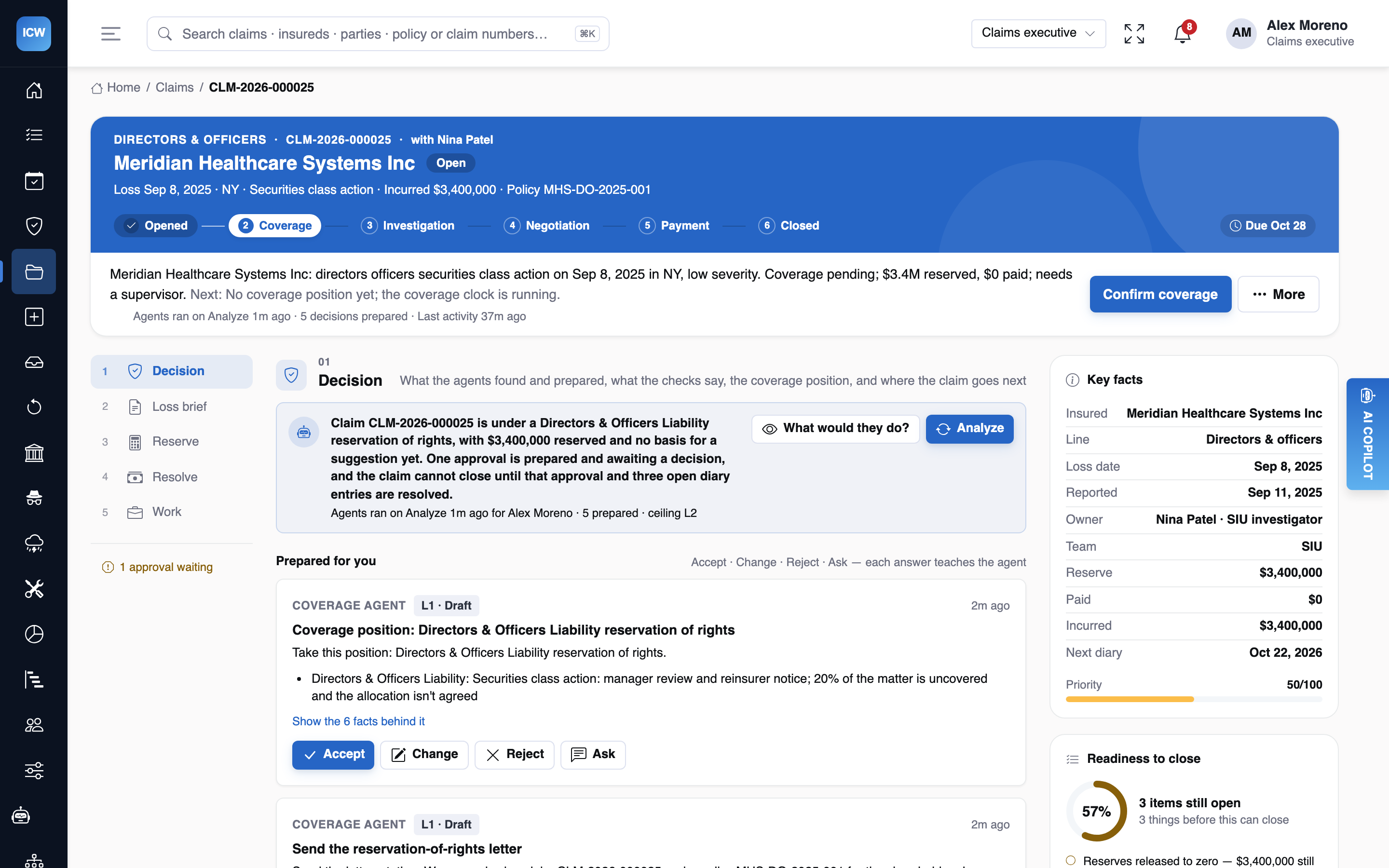
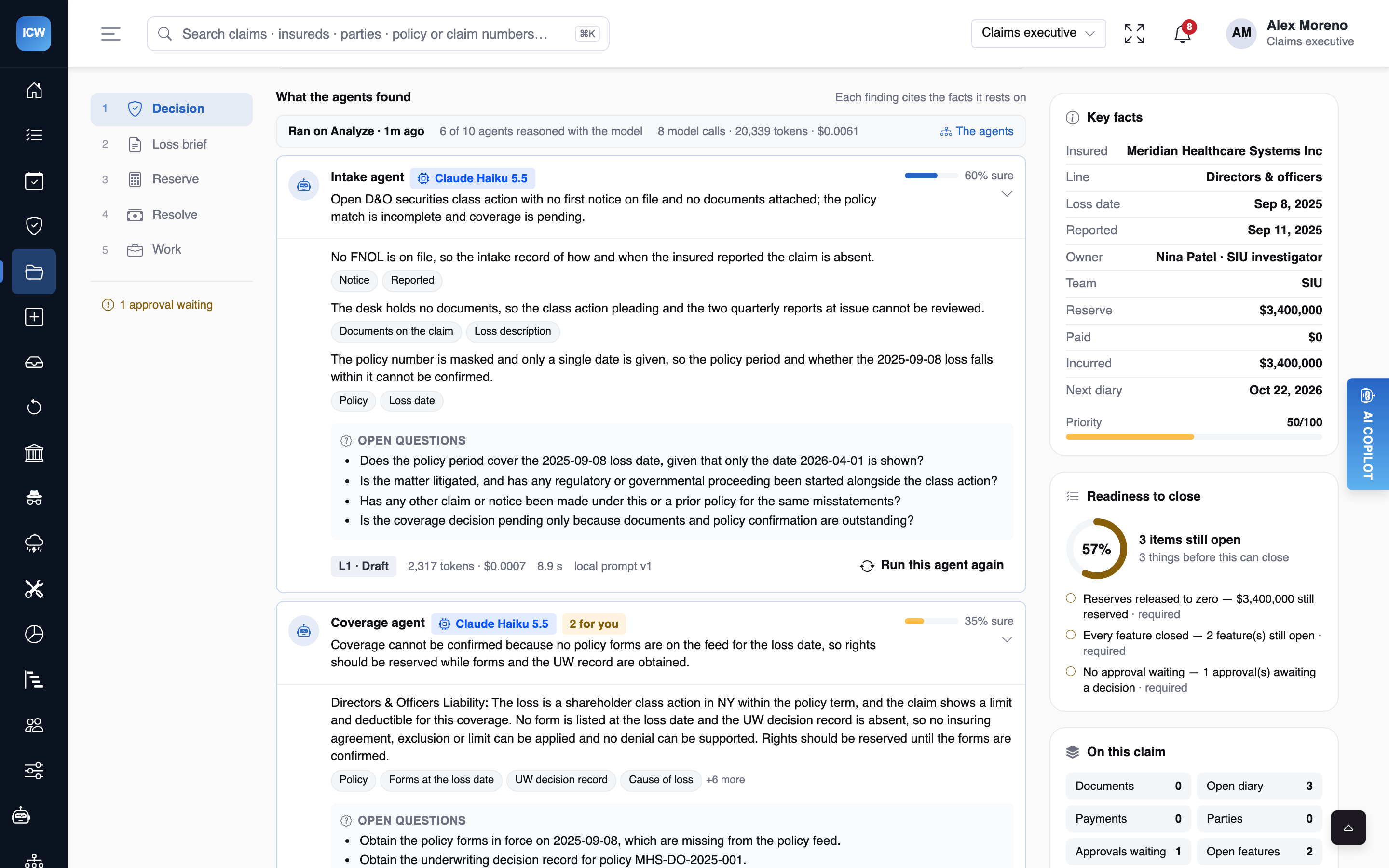
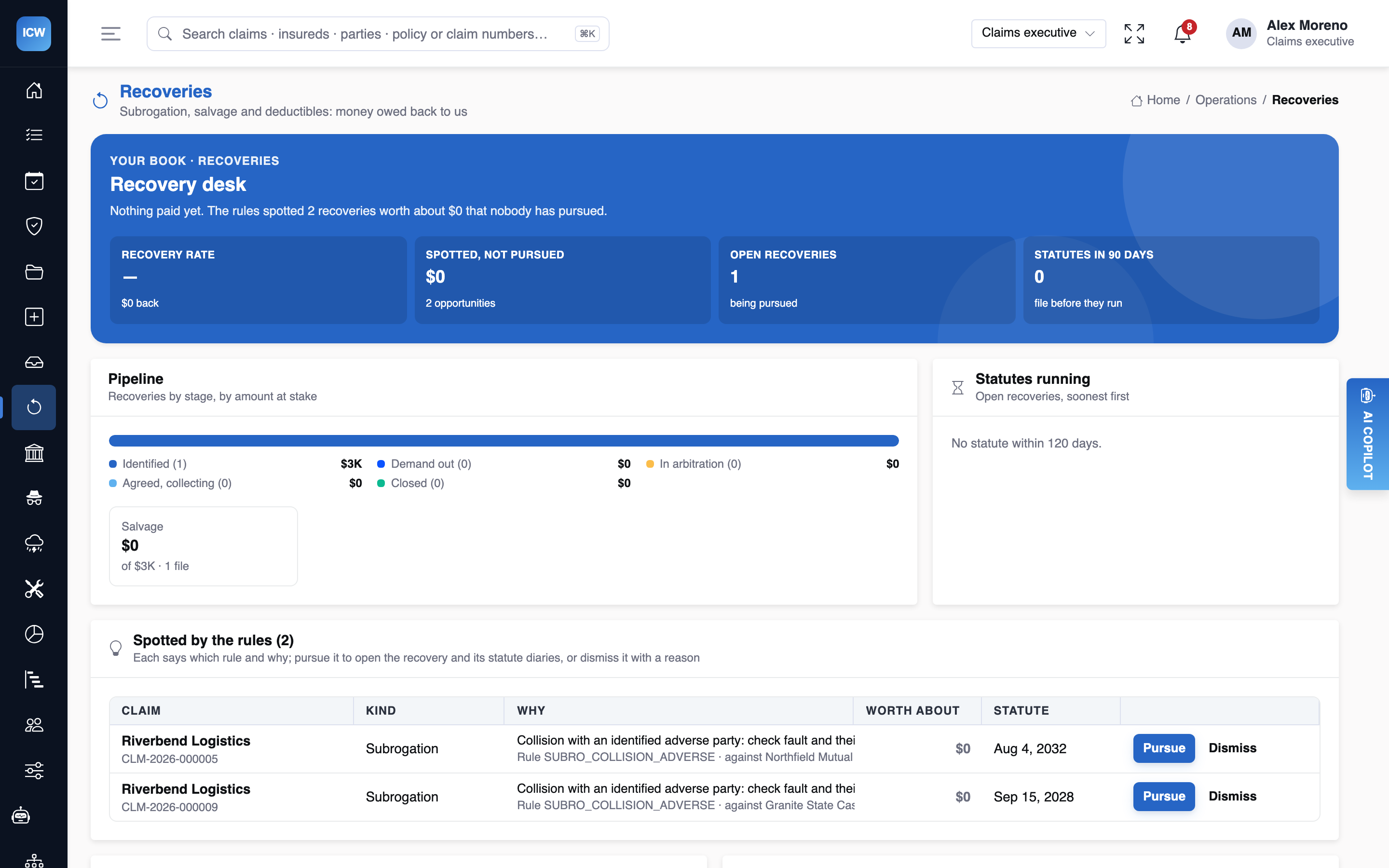
What the agents said, and what each answer rests on
| Agent | What it prepared | What it cites | Who decides |
|---|---|---|---|
| Intake | Notice complete except the police report number; information request drafted | Notice fields, attached documents, policy term from UW, duplicate search on the policy | Adjuster sends or edits |
| Coverage | Collision and property damage covered | Coverage lines and deductible on the policy at the loss date (UW) | Adjuster confirms |
| Reserving | Reserve at the median of closed collision claims on the line | Closed comparables (at least three), the line, the feature type | Within authority: adjuster |
| Subrogation | Open subrogation against the adverse carrier; limitation date stated | Recorded liability, adverse party and carrier in the file, paid to date, loss state | A person, always |
| Correspondence | Status update due on the 30-day clock | The status-update clock, the claim's state | Adjuster sends |
| Closure | Ready to close; closing letter drafted | The closure checklist, every item met | A person, always |
Where the model is, and where it is not
Each agent first works out its facts with rules and the ledger — the reserve's basis, the recovery estimate, the limitation date. The model then reads those facts with the file and writes the explanation, the open questions and the confidence. Any number in what the model writes must already be one of the facts; if it is not, the model's answer is thrown away and the rules' sentence stands. The figures are the engines'. The reasoning is the model's.
Edge cases, and how authority stops them
| What happens | What InsightCW does |
|---|---|
| Fault is shared, 60/40 | SUBRO_ADVERSE_LIABILITY still fires at 50% or more; the estimate uses the recorded share. Below 50% the rule stays quiet and the adjuster can still add an opportunity by hand. |
| The insured's car is a total loss | SALVAGE_TOTAL_LOSS opens a salvage opportunity beside the subrogation one: assignment, pickup, title, auction, proceeds. |
| The model names a carrier that is not in the file | The finding is dropped. A liable party the model names must appear in the file. |
| Nobody acts on the opportunity | The limitation-date diary comes due on the owner's work queue ahead of the date; Up next ranks it with the other items by time and money at stake. |
| A manager raises the subrogation agent's level | It makes no difference: opening a recovery opportunity is capped at L2 whatever the dial says. The agent prepares; a person opens. |
| The recovery payment matches a payment already received | The ledger keeps every receipt with its source; a duplicate receipt is visible on the financials zone before the claim can close. |
The decision record for this claim
Every Analyze writes one run to the claim's decision record: the hits in order, then a verdict. The verdict is a ranking, not a vote — decline beats hold, hold beats refer, refer beats needs-info, and only a claim with none of those proceeds. On day 7, after liability was recorded, the run read:
| Section | Hit | Outcome |
|---|---|---|
| Coverage | Collision covered; property damage covered (policy at the loss date from UW) | pass |
| Severity | Medium: no injury, no suit (SEV_INJURY_LIT did not match) | pass |
| Fraud | Score 0; no live indicators | pass |
| Authority | Outstanding reserve inside the owner's reserve authority; no approval waiting | pass |
| Clocks | Acknowledgement met; first contact met; status update due in 23 days | pass |
| Recovery | SUBRO_ADVERSE_LIABILITY: the adverse party carries 100% of the liability | warn |
| Recovery | SUBRO_COLLISION_ADVERSE: collision with an identified adverse party | warn |
| Agent | Subrogation opportunity prepared; limitation date stated (source: agent) | warn |
The verdict is proceed — nothing blocks the claim — but the recovery hits are on the record with the rule that raised them and the facts it read. An auditor can see, months later, that the opportunity was identified on day 7, prepared the same day and opened on day 8, and by whom.
Ask the copilot
The claims copilot answers questions about the claim on screen. It plans, calls read-only lookups on the claim in the asker's scope, and answers with numbered sources; every figure it writes is checked against what the lookups returned. It suggests actions as links into the workspace and never takes one.
| Ask the copilot | Lookups it calls | What the answer covers |
|---|---|---|
| “What do we stand to recover, and by when?” | reserves_and_payments, litigation_recoveries_siu, claim_overview | Paid to date, the open opportunity's estimate, the limitation date and days left; a link to the recovery. |
| “Has the other carrier responded to our demand?” | litigation_recoveries_siu, diary_and_clocks, notes | The demand's status, the diary that follows it up, and any note recording a response. |
| “Is this claim ready to close?” | claim_overview, reserves_and_payments, diary_and_clocks | The closure checklist item by item; the recovery is the soft item a claim may close over. |
| “How do similar collision claims usually go?” | similar_closed_claims | Statistics across the whole book; named examples only from the asker's own book. |
Tuning it for your book
- The liability threshold.
SUBRO_ADVERSE_LIABILITYfires at 50% adverse liability. A carrier in a pure comparative fault state may want it lower; one that only pursues clear cases may want it higher. It is a rule in the Studio: change it, test the draft against open claims, see how many it would touch, publish. - The limitation dates. The statute-of-limitations rule per state drives the diary. Check each state you write against your counsel's table before relying on it.
- Autonomy for the subrogation agent. Its one action is capped at L2, so the dial only moves it between “draft” (L1) and “ask first” (L2). Most desks start it at L2 so the prepared opportunity lands in the queue as a decision.
- Small recoveries. If your desk does not pursue recoveries below a minimum, add that as a condition on the recovery rules rather than leaving adjusters to ignore the hits — ignored hits are noise, and noise trains people to stop reading.
On the desk
The opportunity arrives in your queue with the carrier, the estimate and the date already worked out. You decide whether it is worth a demand; the template and the diary do the rest.
For claims IT
Recovery rules are recovery rules on the shared engine; the agent proposes through the governed tool registry; money back posts through the ledger and emits claim.recovery_received to Cede, UW and Pulse.
For claims leadership
Unpursued subrogation is quiet leakage. The measure is opportunities opened against paid collision claims with an identified adverse party, and limitation dates missed, which should be zero.
Variations on this claim
The adverse driver is uninsured
The recovery rules still fire: fault is fault. What changes is the subrogation agent's estimate of what is collectable, and the person's decision about whether a demand is worth sending. The agent says what it does not know — that no carrier is on file — rather than inventing one, and a carrier name the model produces that is not in the file is dropped.
A commercial fleet claim with a large deductible
On a large-deductible programme, the carrier pays inside the insured's deductible and bills it
back. DEDUCTIBLE_LARGE raises a deductible opportunity when paid amounts inside the
deductible are not yet billed, and the bill goes to InsightUW as claim.deductible_billed,
where it sits beside the claim for the account's renewal. Two recoveries, two counterparties, one
file.
The other driver is injured and sues
A bodily-injury feature opens, severity moves to high, and recording the suit starts the agents again — now with the litigation agent reading the suit and the medical review agent reading the bills. The subrogation opportunity does not disappear: recovering the physical damage from the adverse carrier and defending the injury claim run side by side. The litigated claim post follows that path.
The car is a total loss
SALVAGE_TOTAL_LOSS opens a salvage opportunity: assignment, pickup, title, auction
and proceeds are tracked on the claim, and proceeds post through the ledger as a recovery. The
net loss that InsightCede and InsightUW see falls when the proceeds land, not when someone
reconciles a spreadsheet at month end.
Rolling it out on your desk
Start with the facts the rules need. Recovery rules read the recorded liability: the adverse party, their carrier and claim number, and the adverse liability percentage. If adjusters do not record liability, nothing fires — so the first week is about the habit of recording it, which the line panel and the workspace make a two-minute step.
- Week 1: publish the recovery rules as shipped, with the subrogation agent at L1 (draft only). Read the prepared opportunities in a weekly review without acting on them.
- Weeks 2–4: move the agent to L2 so opportunities arrive as decisions in the queue. Every Accept, Change or Reject is feedback on the agent.
- Month 2: read the agreement rate on the Autonomy page — accepted divided by accepted plus changed plus rejected over 30 days. The action is capped at L2, so the number tells you about quality, not about promotion.
- Ongoing: watch limitation dates passed with an opportunity open. The target is zero, and the diary makes it achievable.
What the person still decides
- Whether coverage is confirmed. The coverage agent prepares; the adjuster confirms.
- Whether to pursue. A small recovery against an uninsured driver may not be worth a demand. The agent says what is recoverable and by when; the person decides whether it is worth it.
- What to accept. An adverse carrier's offer of 80% on disputed fault is a negotiation, not a calculation.
- When to close. Closing is capped at L2. The closure agent can only prepare it.
What to measure
Three numbers say whether this use case is working: the share of paid collision claims with an identified adverse party that have a recovery opportunity opened; the median days from liability recorded to demand sent; and the number of limitation dates passed with an opportunity still open, which should be zero. The measurement post describes how each is read from InsightCW's own ledger, and the leakage post explains why unpursued recovery is one of the largest quiet leaks in a claims operation.