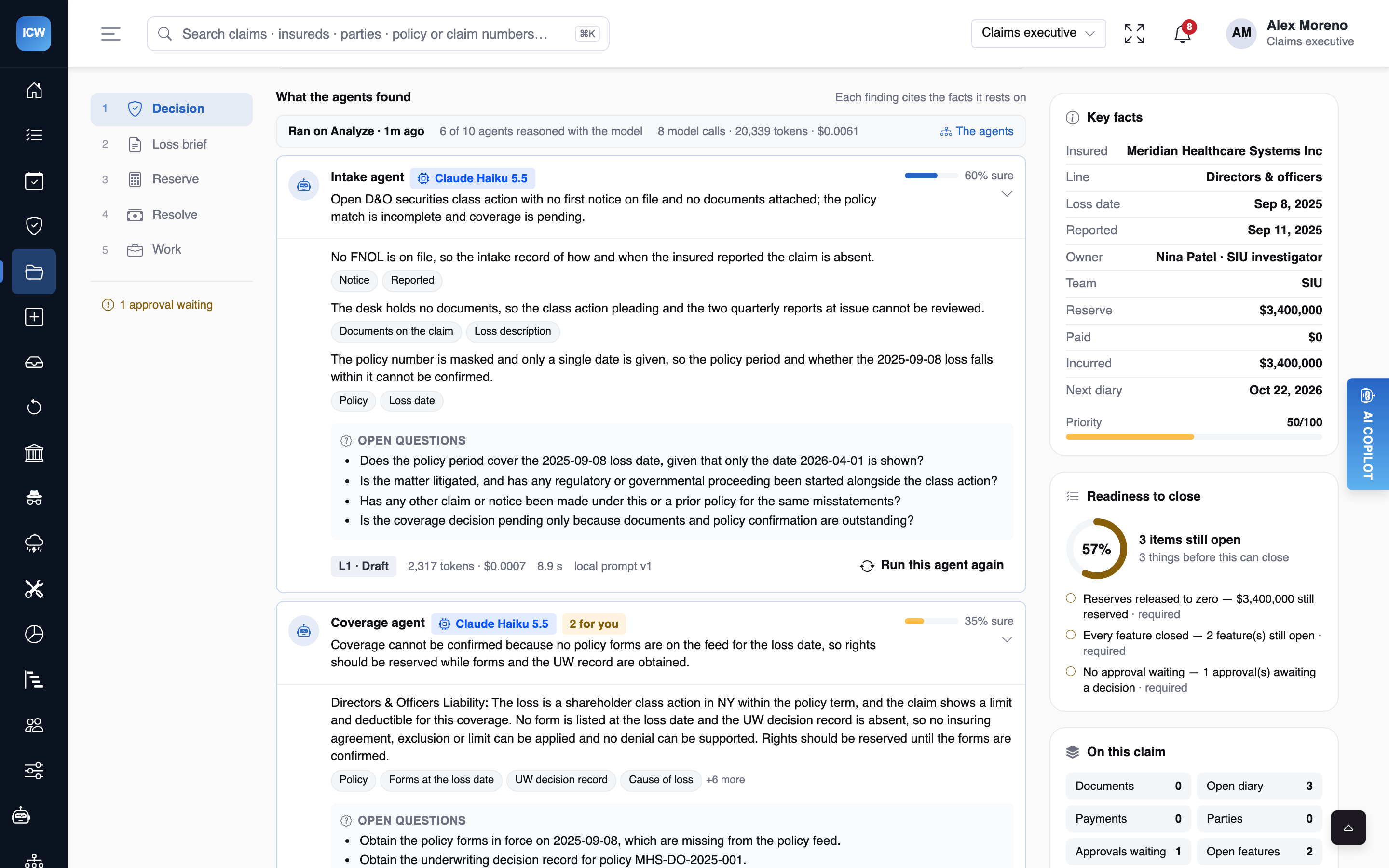
Ask a claims system why a claim was referred, held or denied and the honest answer is usually “someone decided”. The claims decision record is InsightCW's answer to that question: every evaluation of the claim, the hits it produced in order, the rule and facts behind each, and a verdict.
When a run is written
A run is written on FNOL conversion, on claim opening, on every Analyze (including autorun), and on every decision event — a coverage position, a stage action, a payment held or released. Runs are never overwritten; the record is the claim's history of decisions.
What a run holds
| Section | What it says |
|---|---|
| Coverage | The position per coverage, with its form, limit, remaining limit, deductible and reason |
| Line | The line's own checks and its required documents |
| Severity | Severity and complexity, and the rule that set them |
| Fraud | The score and the live indicators, with the rules that raised them |
| Authority | The owner's reserve authority against the outstanding reserve, and approvals waiting |
| Fast track | Eligible or not, and why |
| Clocks | The clocks running, breached ones first |
| Payment holds | Payments parked by a control, with codes and reasons |
| Event | What was decided, by whom, with the reason |
| Agents | What the agents found and prepared, as hits with source “agent” |
The verdict is a ranking
every coverage denied"] --> H["hold
a payment held"] H --> R["refer
coverage referral, authority
exceeded, SIU-level score"] R --> N["needs_info
a coverage without
a position"] N --> P["proceed"] style D fill:#fdecec,stroke:#e57373 style H fill:#fdecec,stroke:#e57373 style R fill:#efeafe,stroke:#7c6cf0 style P fill:#e8f8f4,stroke:#22c1a4
The highest-ranked outcome present wins. A held payment outranks a referral; a referral outranks a missing coverage position. Agents never change the verdict: their findings sit beside the rules' hits, and the verdict is the rules'.
Why this matters beyond the desk
- Audit and market conduct. Why a claim was referred, held or denied, on what facts, by which rule, and who answered.
- Rules governance. Rule owners see which rules fire, how often, and how people answered what they produced.
- Agent governance. Agent findings are recorded as hits with source “agent”, so their influence on a decision is visible.
The record is built on the platform's shared decisions package, the same one InsightUW uses for submissions, so the shape is identical across products.