A fire takes out a distribution warehouse on a commercial property policy. The first inspection puts the building and stock loss well past a million. Within a day, three audiences need to hear about it: the claims manager whose authority the reserve exceeds, the reinsurers whose treaty it will reach, and the executives who will be asked about it at the next board meeting. Each tends to hear a different number on a different day.
This post follows one large loss through InsightCW: the reserve that goes above the adjuster's authority, the per-line threshold rule that issues the large-loss report once, the reinsurers' notice to InsightCede, the update that follows when the incurred moves by a quarter, and the portfolio that the board pack reads. The insured and amounts are illustrative.
| Actors | Property adjuster (owner), supervisor and claims manager (authority), reinsurance team, claims leadership |
|---|---|
| Trigger | A reserve that takes a commercial property claim's incurred over the line's large-loss threshold |
| Line | Commercial property (the same rule exists per line: auto, property, general liability, workers' comp, commercial property) |
| Agents involved | Reserving, coverage, supervisor, subrogation (cause and origin), correspondence |
| Decisions and authority | The reserve above authority (escalated through the matrix), the large-loss report (issued by rule, read by people), every payment |
| Systems touched | InsightCede (claim.large_loss and every reserve movement), InsightUW (the account's experience), InsightPulse (portfolio) |
| Outcome | One number, issued once, to every audience; updates when it moves materially; no surprises at quarter end |
| What is measured | Hours from threshold crossing to report, reports updated when incurred moved 25%+, reserve development on large losses, agreement between the board number and the reinsurance number |
Why large losses get reported three times, differently
posted"] --> B["Manager hears
by email"] A --> C["Reinsurance hears
at bordereau time"] A --> D["Board hears from
a spreadsheet"] B --> E["Three numbers,
three dates"] C --> E D --> E style E fill:#fdecec,stroke:#e57373
Large-loss reporting is usually a set of habits: an email to the manager, a line on the next bordereau, a slide built from a spreadsheet. Each is reasonable and each reads the claim at a different moment. InsightCW makes it one rule per line and one ledger underneath every audience.
adjuster's authority?"} B -->|"no"| C["Approval to the next role,
prepared by the supervisor agent"] C --> D["Reserve posted
through the ledger"] B -->|"yes"| D D --> E["large_loss rule:
incurred at or over
the line threshold"] E --> F["Report issued once:
management report,
manager queue,
claim.large_loss to Cede"] F --> G["Incurred moves 25%+:
update report and notice"] style F fill:#efeafe,stroke:#7c6cf0 style C fill:#e8f8f4,stroke:#22c1a4,stroke-width:2px
The thresholds
Each threshold is a large_loss rule in the Rules Studio, one per line, so a claims
executive can read and change it. The seeded defaults:
| Line | Reported at incurred of |
|---|---|
| Auto | $100,000 |
| Property | $250,000 |
| General liability | $250,000 |
| Workers' comp | $250,000 |
| Commercial property | $500,000 |
Who talks to whom
a claim is noticed once, whichever path gets there first
Step by step
The policy at the loss date from InsightUW: building and stock limits, coinsurance, the deductible. The property line's checks run, including coinsurance (PR_COINSURANCE).
From the first inspection estimate, by component: building and stock indemnity, expense. Its basis is the estimate in the file; the line's benchmark is shown beside it as illustrative, never as the number.
The seeded matrix lets an adjuster reserve up to $25,000, a senior adjuster $100,000, a supervisor $500,000 and a manager $5,000,000. A seven-figure reserve goes to the claims manager as an approval with a 24-hour decision clock.
The brief: the authority gap, the approver's limit, precedent on the line over 12 months, the reserve history and the reserving agent's figure with its basis. Its recommendation may only tighten.
The reserve posts through the ledger with its reason. claim.reserve_movement reaches InsightCede at once.
Incurred is over the commercial property threshold, so the report is issued once: a management report from the template, kept on the record; the manager queue told; and claim.large_loss to InsightCede as the reinsurers' notice and to InsightUW for the account.
If the fire's cause points at a product or a contractor, the recovery rules (SUBRO_PRODUCT) prepare an opportunity: preserve the item, put the manufacturer on notice.
Stock values come in higher; incurred moves by more than 25% since the last report. An update report and notice follow automatically, so nobody has to remember that the first number is stale.
What the screens show
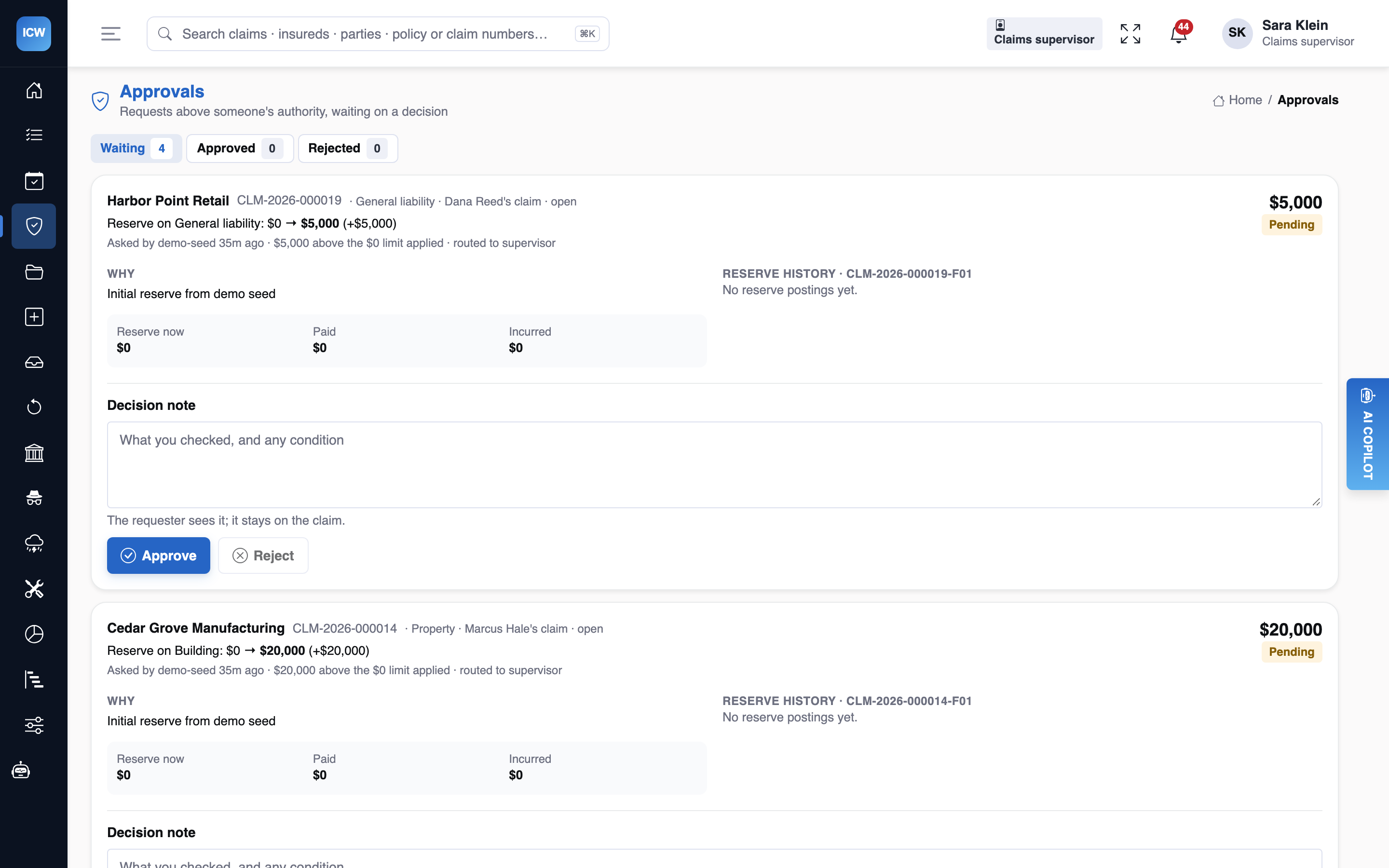
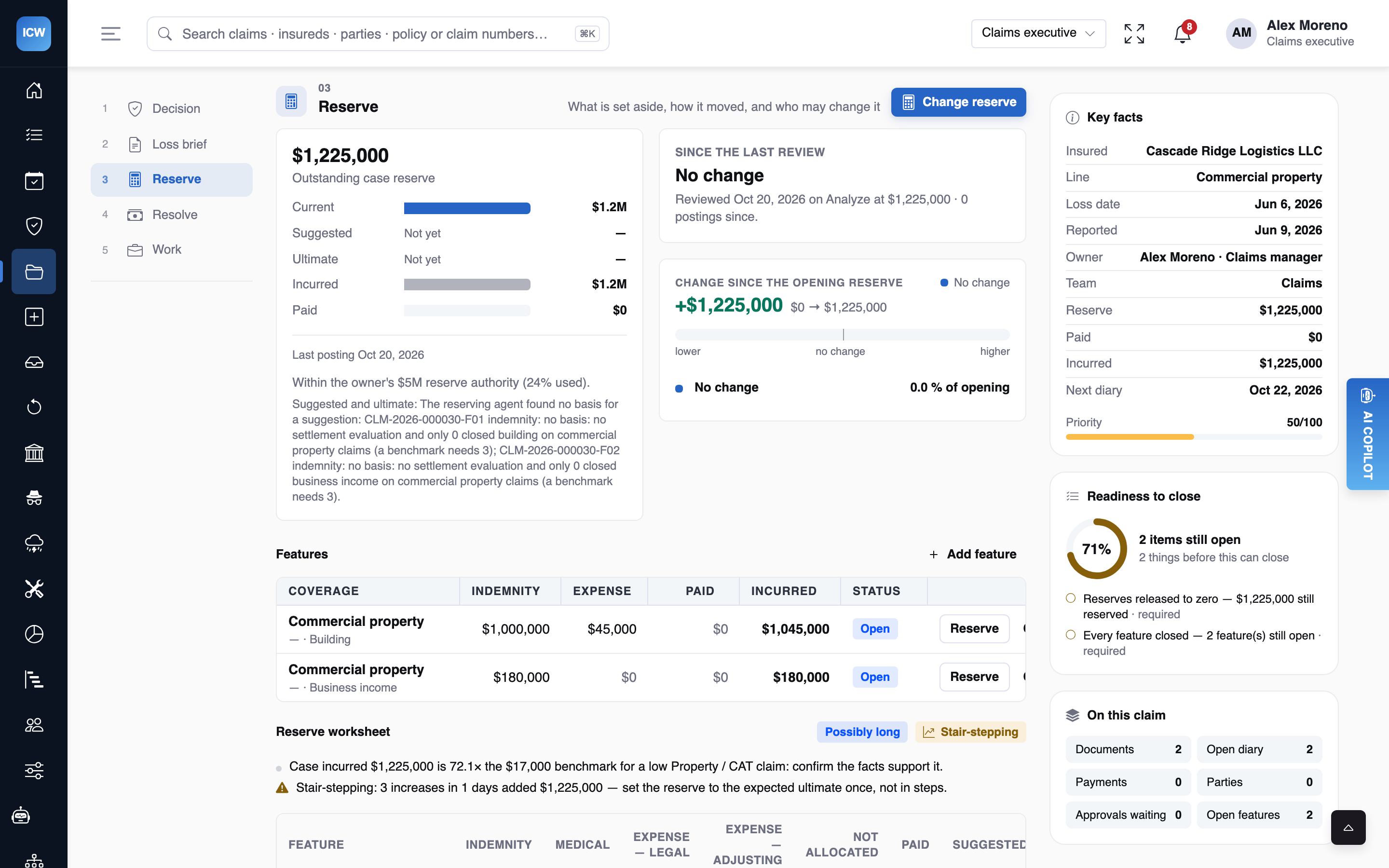
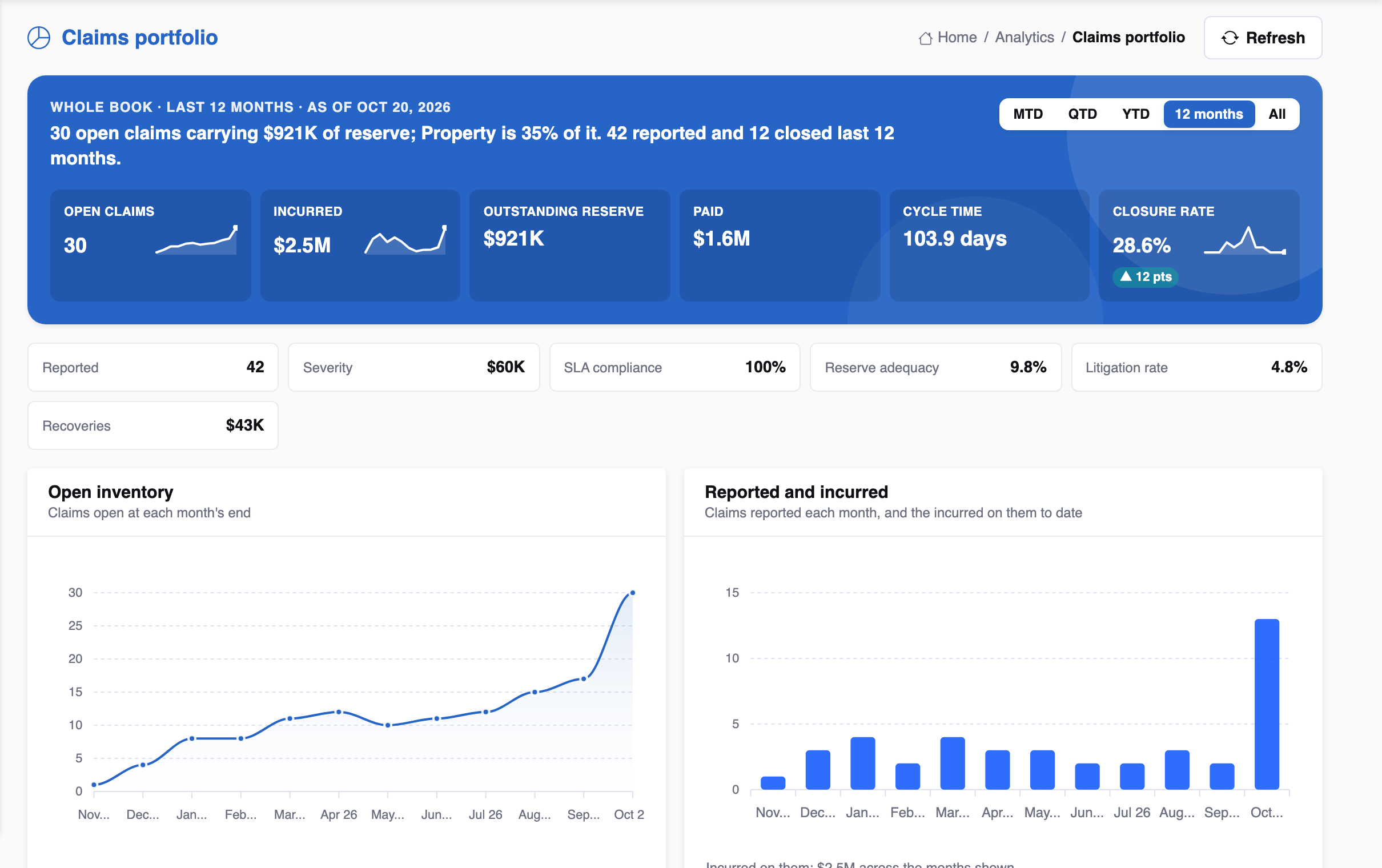
What the agents said, and what each answer rests on
| Agent | What it prepared | What it cites | Who decides |
|---|---|---|---|
| Reserving | Reserve by component from the inspection estimate | The estimate document, policy limits, coinsurance | Above authority: manager |
| Supervisor | Approve; precedent supports the figure | Authority gap, approver's limit, 12-month precedent, reserve history | Claims manager |
| Coverage | Building and stock covered; coinsurance to be confirmed | Policy at the loss date, PR_COINSURANCE | Adjuster |
| Subrogation | Possible product cause: preserve the unit | SUBRO_PRODUCT, the inspection notes | A person, always |
Edge cases, and how authority stops them
| What happens | What InsightCW does |
|---|---|
| The reserve is approved in two steps | The report is issued when incurred first crosses the threshold, once; the second step is an update only if it moves incurred 25% or more. |
| Both the general notice and the line rule fire | They share one event id, so InsightCede hears it once. |
| An agent at L3 changes the reserve | It still needs the same authority as a person; above it, the change becomes an approval. |
| A threshold is wrong for the book | Change the rule in the Studio, test the draft against real claims, publish. |
The decision record for this claim
On day 2, after the approval, the run read:
| Section | Hit | Outcome |
|---|---|---|
| Coverage | Building and stock covered on the policy at the loss date | pass |
| Line | PR_COINSURANCE: coinsurance penalty may apply; values to be confirmed | refer |
| Severity | Critical: incurred and complexity | warn |
| Authority | Reserve approved by the claims manager inside the manager's authority | pass |
| Large loss | Commercial property at or over the reporting threshold: report issued, reinsurers told | warn |
| Agent | Possible product cause: preserve the unit (source: agent) | warn |
The management report
The large-loss report is built from a template and kept on the record, so what the manager read on day 2 is what the auditor reads later. It names the claim, the insured, the line, the loss date and state and why it was issued; the position (incurred, paid, outstanding reserve and the threshold it crossed); what happened; the exposures by feature; and the handling — who owns the claim, the coverage position, and whether it is in suit or with SIU. When incurred moves by 25% or more since the last report, an update report follows with the same structure, so the history of a large loss reads as a series, not a pile of emails.
Ask the copilot
| Ask the copilot | Lookups it calls | What the answer covers |
|---|---|---|
| “What's changed on this claim since the last report?” | reserves_and_payments, decision_record | Reserve changes since the last report with reasons; whether an update report is due. |
| “Is the reserve adequate?” | reserves_and_payments, decision_record | The reserve now, the suggested and ultimate figures with their basis by feature, and the change since the last review. |
| “Is coinsurance going to bite?” | policy_and_coverage, decision_record | The coinsurance clause from the policy at the loss date and the line check's status. |
Tuning it for your book
- The thresholds. Set each line's threshold to what your treaty notice provisions and your executives expect — they are often different numbers, and the lower one should win.
- The update trigger. 25% movement since the last report is the default.
- Authority. The matrix is seeded; replace it with your own by role, transaction type and amount, including the escalation role.
On the desk
You post the reserve; the report, the queue notice and the reinsurers' notice happen without another email.
For claims IT
large_loss rules per line; the report is issued once and shares an event id with the general large-loss notice; Cede receives claim.large_loss on its signed intake.
For claims leadership
One ledger behind the board pack, the reinsurance notice and the manager's queue. Measure hours from threshold to report.
Variations on this claim
A large liability loss
General liability reports at its own threshold. A litigated large loss carries the suit into the report's handling section, and the litigation agent's spend-against-budget view becomes part of the story leadership reads.
Reserve released after the report
If the incurred falls by 25% or more since the last report — a recovery, a settlement below the reserve — the update follows in the same way. Good news is reported with the same discipline as bad.
A catastrophe-tagged large loss
A large loss inside a catastrophe is reported on its own and also counted in the event roll-up. Because the event roll-up is a notice and not a cession, the reinsurers see both views without the dollars being counted twice.
Rolling it out
- Agree the thresholds with reinsurance and leadership; publish them as rules.
- Load the authority matrix by role, transaction type and amount, with escalation roles.
- Connect InsightCede so
claim.large_lossand every reserve movement arrive on its signed intake. - Measure hours from threshold to report and the agreement between the board number and the reinsurance number.
Questions we get asked
Who sets the thresholds?
Claims leadership, as large_loss rules per line in the Rules Studio. The seeded defaults are a starting point.
Does a large loss go to Cede twice if two rules fire?
No. The line rule and the general large-loss notice share one event id, so InsightCede hears it once.
Can an auditor replay what happened?
Yes. Every Analyze, stage action and payment hold writes a run to the decision record, with the hits in order, the rule and facts behind each, and the verdict. Every agent step records its model, tokens, cost and confidence, and a Lense trace when tracing is configured.
Which model do the agents use, and what if it is unavailable?
By default the agent steps use Claude Haiku 5.5 through the platform's model client (on Bedrock where a region is configured), with a daily budget per agent; over budget, the fast model answers. If no model is configured, or a call fails, or the answer does not parse, the agents' rule-based findings stand and the step says the model did not run. Nothing in the claim waits on a model.
What the person still decides
- The reserve, at the authority level it needs.
- What the report says beyond the facts — the narrative leadership reads.
- The threshold itself, as a published rule.