The fastest way to fail with claims agents is to switch everything on at once, on every line, and ask people to trust it. The way that works is narrower: one line, one desk, the agents preparing rather than acting, and a quarter of evidence before anything moves.
Weeks 1–2: foundations
- Pick one line with volume and clear rules — auto physical damage or property are typical. Avoid starting on a line where every claim is bespoke.
- Connect the policy lookup to InsightUW, and check it answers for policies that have renewed since a loss.
- Load your rules: the authority matrix, the clocks for your states, the assignment and severity rules, the payment controls, and the line's checks. Replace every illustrative default you can.
- Load closed claims on the line. The reserving agent needs at least three closed comparables before it will offer a benchmark; with fewer it says “no basis”.
Weeks 3–4: agents at draft
With every agent at L1, the agents draft and nothing is put to anyone as a decision. Use the time to read what they produce on real files in a weekly review: are the citations right, are the open questions the ones your best adjuster would ask, does the reserving agent's basis make sense.
Weeks 5–12: ask first, on one desk
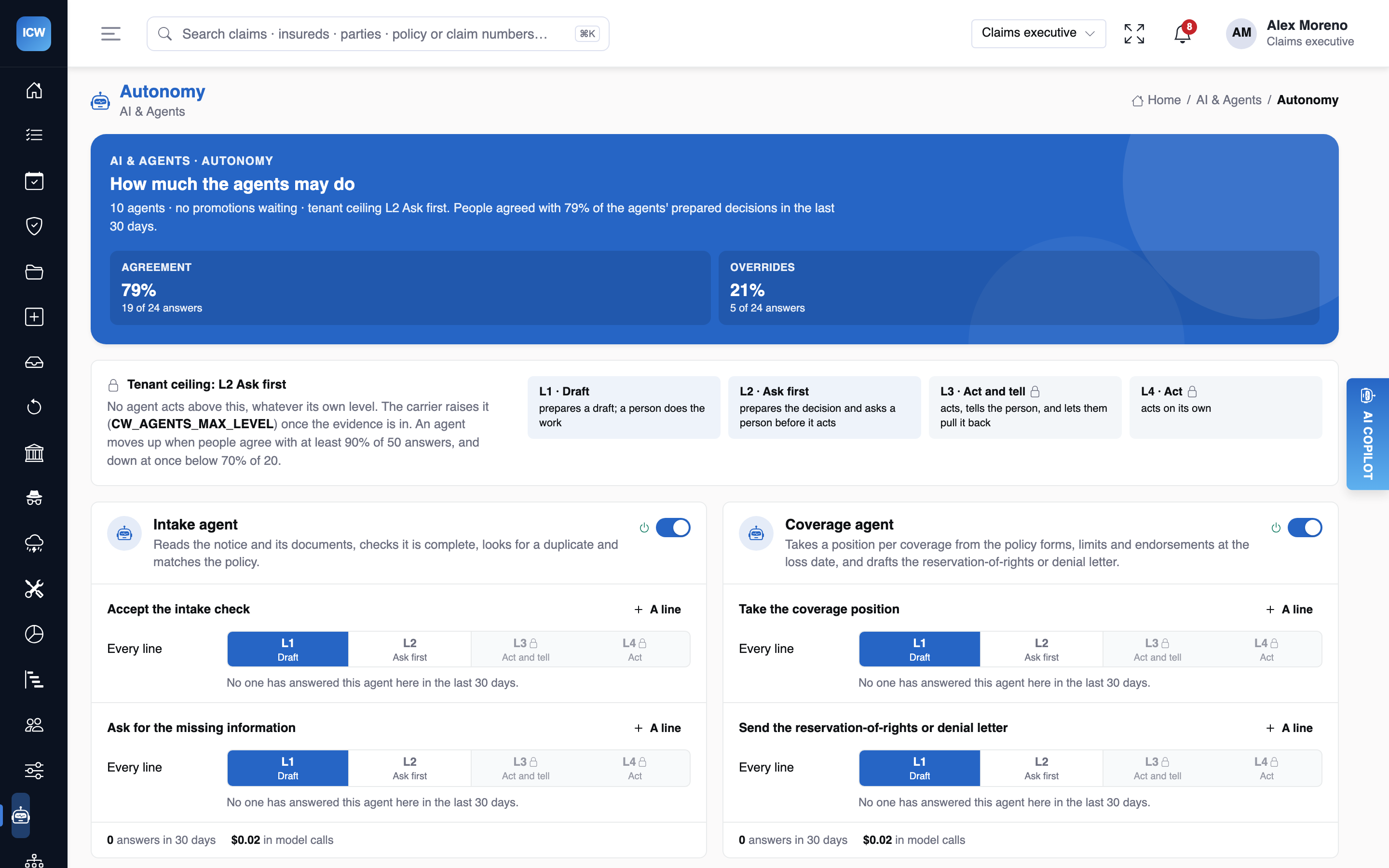
Move the agents to L2 on one desk. Prepared decisions arrive in the queue; adjusters Accept, Change, Reject or Ask. Every answer except Ask is recorded as evidence about the agent, rolled up hourly by agent, line and action.
Day 90: read the evidence
- Agreement per agent and action. Promotion is recommended at 90% or more over at least 50 answers; anything below 70% over 20 answers is demoted automatically. Neither number is a reason on its own to raise the ceiling.
- The measures in measuring it — cycle time, clocks met, reserve changes per claim, recoveries opened — against the same desk's previous quarter.
- What people changed. The Change answers say where the agents are almost right; those are prompt and rule improvements.
When to raise the ceiling
Only for actions where agreement is high, the action has a pull-back, and being wrong is cheap and visible. Letters and information requests are typical first candidates. Six actions never move past ask-first: SIU referrals, approvals, subrogation, defense review, medical review and closing a claim.